

 Amazon Music
 iHeartRadio
 Apple Podcasts
 Spotify
 Pandora
 YouTube
 First Things First - Vandalyn Kennedy | Faithly Podcast
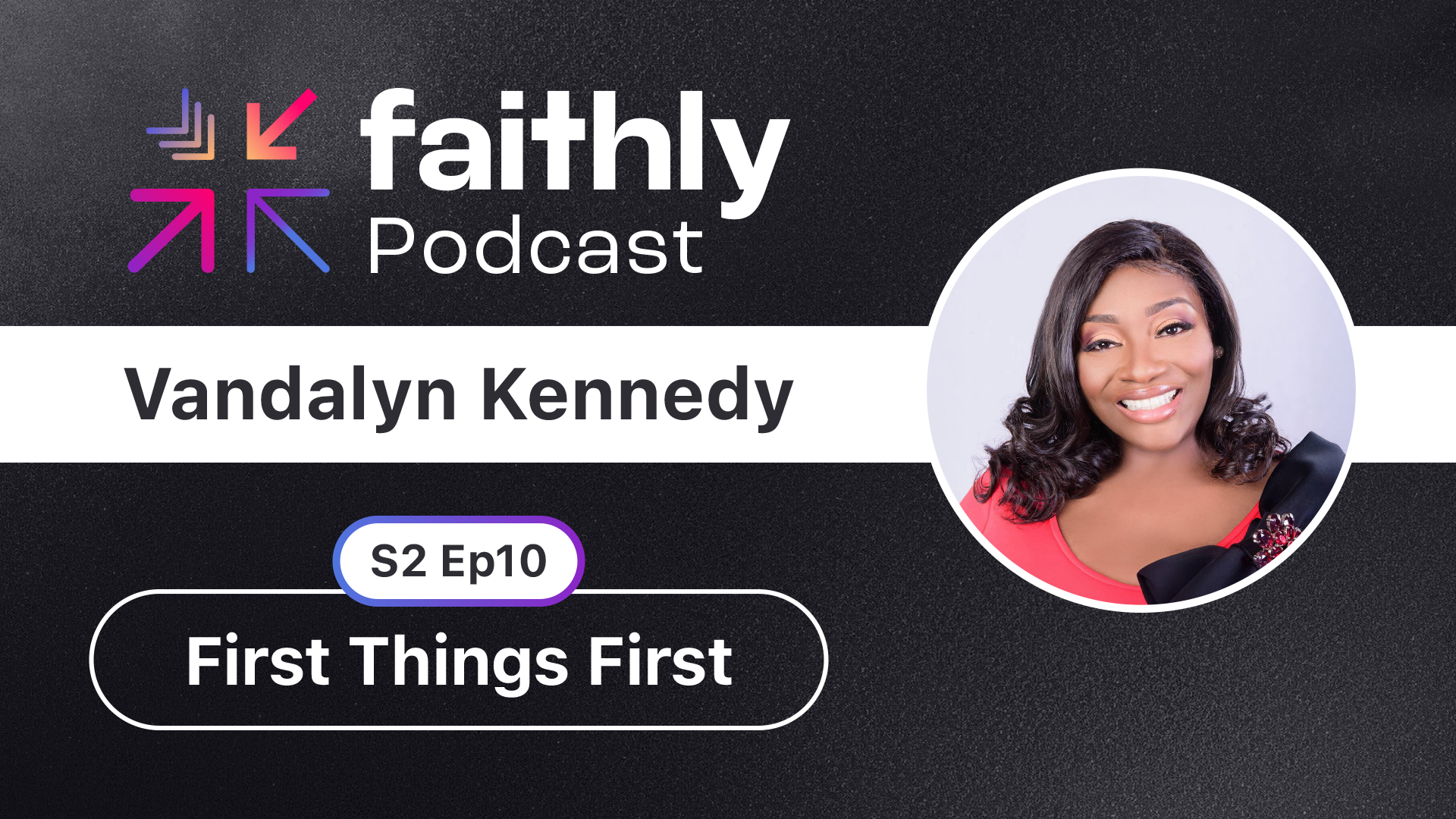
Join Rev. Adam Durso on today’s episode of the Faithly Podcast as he sits down with Reverend Vandalyn Kennedy—leadership strategist, youth ministry leader, and author of ‘First Things First’—as they dive into calling and leadership within ministry, as well as the formation required to serve the next generation well.
Vandalyn shares her journey from a strong church upbringing through personal challenges to becoming a globally influential voice in youth leadership. Along the way, she reflects on how a renewed and authentic relationship with God reshaped both her life and her ministry, grounding everything she now teaches in real spiritual transformation.
Together, Rev. Adam and Vandalyn explore what it truly takes to develop effective leaders today, highlighting the need for both spiritual depth and practical strategy. They candidly acknowledge the gaps in traditional ministry training and the growing challenges facing younger generations, pointing to the reasons that leaders need to be equipped to meet people where they are without compromising the truth. Drawing from the heart of her new book, ‘First Things First’, Vandalyn emphasizes the importance of spiritual discipline and inner healing to achieve healthy rhythms, reminding leaders that sustainable ministry flows from a life rightly ordered before God.
Website: https://www.vandalynkennedy.com/about-vandalyn-kennedy
(00:00) Creating Space for the Next Generation to Lead
(01:24) From Church Roots to Personal Transformation
(03:28) Discovering Purpose Through Leadership and Service
(05:10) Strategy and Spirituality Working Together
(08:00) Preparation Over Performance in Ministry
(10:30) Reaching Young People Through New Methods
(13:00) Community, Isolation, and Mental Health Challenges
(17:00) Meeting People Where They Are Beyond Church Walls
(20:30) Empowering Emerging Leaders Instead of Limiting Them
(25:00) Sustaining Leadership Through Spiritual Health and Boundaries
Follow us on social media:
Website: https://faithly.co/
Facebook: https://www.facebook.com/thefaithlyco/
Instagram: https://www.instagram.com/faithly.co/
LinkedIn: https://www.linkedin.com/company/faithly/
X: https://x.com/faithlyco
I think between old models of you have to wait till a certain time, between that, between leaders who are insecure, who are afraid that someone is going to take their spot, we're not putting them in the game, but watch this, they're creating their own game. This is the Faithly Podcast. My name is Pastor Adam Dersot, and welcome to another episode of Faithly Podcast. And I have the opportunity to sit here with the tremendous Reverend Vandolin Kennedy Seosup Vandolin. Oh, what an honor. Hello, everyone. And what an honor it is to be here with you, Pastor Adam. Well, and what people don't know, I mean, yes, you are chair lady of the International Youth Department for the Church of God and Christ, which is 6 million strong internationally over youth young adults and youth leaders. But you and I know each other from doing youth ministry in Brooklyn, in Queens 25 years ago, and we still remain friends doing amazing ministry together, and you're crushing it. Listen, many of the spaces that I'm in, you've connected me with some of those people. I just did a workshop the other day, and I mentioned your name because I talked about the youth ministry events you always had, and that I came to and my eyes were open. So thank God. Well, let's talk about it, because you've got a run of ministry and education and degrees. What does the journey look like? Oh, it's been a long day. I grew up in the church. I grew up. I'm the only girl of four children. I feel to brothers. My mom and dad, mom was into education, she was a church musician, father. We had a cleaners in a laundromat town in the street. And so we were raised in Mount Sonic at the age of church of God in Christ, who up in the choir doing all the church things, 16. I went away to Sarah Lawns College. I went away at 16. At 16. Okay. So you're a prodigy. I don't. It wanted to get me out of here. So I'm 16. I go away to college. All I knew was Jesus. I wore skirts and I knew church, but I didn't really know a lot of God. And so someone said, you want to smoke or join? I said sure. Smoked, loved it. 17. You want to do a line of coke? Yeah. 17 and a half full-fledged cocaine habit started selling drugs, 17 and a church girl. Yeah. Long story short, left college, came home, didn't really want to have anything to do with God, but the Lord began to tug on my heart. Isn't that awesome? Even when you're not looking for him, he comes looking for you. All I wanted to do was smoke. Yeah. But he tugged on my heart. He came for me, put a bit in my nose as the Old Testament says, and I came back to the church at about 21 and just started running for God because he really saved me. It wasn't religious this time. Yes. It wasn't tradition. It was the presence of the Lord. So I began to run for God and before I knew it, I was serving and I was being quote unquote elevated. Sure. I didn't know, but my past to begin to acknowledge, almost like Samuel and Eli. Yes. The Lord is calling you. The stand of the Lord is upon your life and I began serving music ministry, youth ministry, everything. And now, here I am. Well, you know, in baseball, they call it a five-tool player, right? They make a hit, run, field, they do the whole thing, then you are the Christian ministry version of a five-tool player. You are, if you can sing, you can pray, prophesy, preach the house down. But there's this other side of you that I don't know if everybody really knows. And that is your tremendous strategist. I mean, we'll talk about your book in a second, by the way. Plug. We'll talk about that in a little bit. But the strategy side of what you do, you have helped and are helping organizations, ministries to be more efficient, more effective, to hit their mark and their goal. What does that look like? Well, a few things. Number one, you mentioned the education, I'm thankful for that. But I realized at a certain point that preaching is necessary, I'm doing it. But I realized that leaders need to be empowered and strengthened. The church many times is the only place that you can come in and they put you in a position and you just have to figure it out. Yes. You could be in charge of a team, you're not taught about strategy, you're not taught how to organize anything, leadership 101, you're good with youth, you're the youth pastor. How do I do a budget? What about conflict resolution? And so the Lord began to tug on me about all of these, this Ivy League training and these degrees. This is so that you can power to Ivy League. Whatever. But this is so that you can empower my people. And so I get great joy, I preach because I have to, I have no choice. The Lord will get me, but when it comes to leadership development and strategy, I get joy out of that. And I get joy out of having the kingdom of God advance through leaders being empowered. And so that's what I get. Because we can do more if we just have strategy. And when it comes to like, I was a youth pastor for many years and so, you know, I'm not on the boots on the ground, youth ministry anymore. But I realized if I helped to empower more leaders and more youth leaders, I can reach more young people exponentially. And so that is the strategy. How can we do what we do for God? But the best that it can be better, more efficient, more effective. And you and I both come out of similar traditions in the Pentecostal circle. And sometimes in those traditions, strategy and education can almost be looked down upon or in conflict with the move of the Holy Spirit. But they're not. How do they work in tandem? We see biblical stories all through the Bible. We see where leaders had strategy, right? The spirit is enough. But the more tools we have, the more information, the more education, and education is not always institutional, right? Degrees are fine. But there are many people who are able to do great things without degrees. So the more you have in your toolkit to use, the more that God can do. I love when it talks about the building of first the tabernacle and then the temple. And it's very clear that they were anointed by the Holy Spirit, but they were gifted in their skill set. They had a gifting to deal with stones or woodwork because God was not going to build something shoddy. And what God is building in the earth today is not shoddy. Not shoddy. As a matter of fact, you mentioned that so many times the psalmist, we see David, ASAP, was anointed and skillful. So we need to be anointed, but we need to be skillful. Moses, God told him, best allow, have the ability to create all of these things for the ark. And so we have to sharpen these skills so that we can be the sharpest tools that we can be. Too often, I think in some of the circles we've been around, we blame sloppiness on the Holy Spirit. It doesn't have to be sloppy. Do you know how many times pass the atom that we have misused the scripture, open your mouth, go and I'll fill it right? That's not what that does not mean. Don't study, right? That doesn't mean lack of preparation. That does not mean lack of preparation. 100% clear. And the spirit of the Lord will move you and show you how to put that. We've got to be prepared and we can't say, well, I'm just waiting for God to do it. No God is waiting for us to be the best we can be so that he can move us into different areas. There are some rooms that I could not go into if I had not had certain credentials. Sure. And that does not mean that in every room you need credentials, but that was where God wanted to use me. Yes. How many places are we not being effective because we're not ready? Yes. God will never violate his word. So sewing and reaping is foundational. Sure. If I read it and I study it, God can pull it out of me and I can reap from it. But if I don't apply it myself, there is, there's nothing God can do because he's not going to violate his word. And so to your point, preparation is the breeding ground for spontaneity. That's great. When we're prepared, God doesn't only give you what you pray for, he gives you what you prepare for. That's great. Because if he gave you what you didn't prepare for, you, the blessing would crush you. Yes. Because you're not ready to receive what you've been asking God for. How many Christians are praying, leaders are praying, God give us, they're not preparing for if God actually answered them. And so the thing that would come would actually be a curse. That's, that's true. Absolutely. You just recently, I got, I was out of town, I was watching it, I was so blessed. You just recently pulled off a sold out no seats left in the building, youth ministry leaders training event right here, we're in New York City, we're right here. We are in the heart of New York City. What was that? Listen. Where did the passion for that come from? Like bringing it back to New York, you're on all these planes every day, you're heading to a plane this evening. But you, this is hometown. So I don't mean any disrespect to the way that I was raised because every opportunity that I have and who I am today, much of it is because of how I was raised in my training in my local church. But I want to say that one day I was sitting in church and my pastor said, we're welcoming our new youth pastor in our context, we never had youth pastors, especially as a woman coming from my denomination, pastor and woman didn't go together. Sure. We're welcoming our new pastor. So we're looking around, Fandall in Kennedy, I'm like, okay, I was a youth leader at the time. Right. But I was not, you know, in that role. So I was like, well, what does that mean? I began to go and look and find information and I connected with people like pastor Adam who was having things at his church, who was hosting refueling, reloading, all kinds of things like that. And I began to learn, I began to bring my team to those kinds of things and I'm like, okay, I need to be better at what I'm doing if I'm going to reach this generation. So I really started a quest, I was already into leadership development, but I really started a quest for, well, not only do I need to be doing youth ministry, I need to be training leaders and if I can do both at the same time, then I can have exponential reach. And so I spent 50% of my time with young people and 50% of my time building leaders. And so that's where it comes from, that passion is, I'm giving out what I wish I had, what I wish someone to tell me, especially in my context, because it's not just all we're going to pray and they're going to get here, no, there were kinds of things that are strategically keeping young people out of our church services and from having a connection with God. So let's talk about those barriers for a second. What are the barriers you're seeing that are keeping young people away from? And in some cases, completely just not understood, like they want young people to come, but their actions or the philosophy or their approach is actually a barrier that is set up to keep young people outside and away from the very thing that they might want and that's come to God. You know, past Adam, we don't remove the ancient landmark. We know that we believe in the Bible, right? We believe in holiness, but the method with which we us, we give that must change. I would not want to go to a bank, I would not want bank with a bank that does not have an ATM, online banking, sure. So we are stuck in the path of how we've done things. And studies show we know Barnabee, Black Millennial Cafe, Brianna Parker, their research shows they're certain things young people want. The trends we're saying young people were leaving the church. Now Barnabee did a study, they're coming back, but they're coming back on their terms. They may not come back every Sunday. They want some digital engagement. They want social justice embedded in ministry. They want holistic ministry. How are their whole lives connected to Christ? They want community. So what does that mean? Small groups. I'm consulting with the church who has a lot of young people in the community, but I could not get them to come in. I said, well, there's a start books on the corner, right? You ever thought about going out and having a Bible study? They have a phenomenal Bible study now once a week at Starbucks at the Starbucks, yes. But some of those people have come to join and some have not. If our goal is Christ and getting them to Christ, it's not about having people in the seat solely. I was in Starbucks in Austin on Sunday, and I was waiting to get my, my, my quad espresso mock out of four shots of espresso. So if you wonder why there's so much energy, that's it. And so I'm standing there and I'm waiting for my, my espresso drink to be made. And I noticed, you know, when Starbucks was really popping back, they, they were the third space. Okay. You know, so it was, you had your workspace, you had your home space, and then they wanted to create this community, third space. But now with the mobile order, they come in, they're, you know, your orders A through M over here and N through Z over here. And nobody looks up, nobody says, please, nobody says, thank you. But there is a group of people that are craving community. They're living in their algorithm, they're living in isolation. How are you seeing that impact young people? And I'll be specific young people in urban context, specifically. So wow, super, super, super duper true, they, I mean, they're, they're busy places. So I'm not talking about rural America. They are in crowded spaces and they're alone and they want to crowd a space alone and alone. Absolutely. And they're, but yet they're craving the community. Yes. They're creating these communities online. Yes. Digital engagement. A lot of communities, a lot of people and even my denomination, they have come together online. They're in Facebook groups and support groups together, right? And so finding ways to make sure that we capitalize upon that and not just say, well, you have to come in here. What are we doing to create those spaces? It's really sad though. It's really sad. And that ties to the mental health crisis also, okay, with young people talking about because this is, as you've seen the research, this Gen Z has the highest anxiety rates and suicide rates. Yes. And so with the world, everything that's happening, we're not creating that connection that would allow them to be able to connect in real ways around real things. Yes. That's the other thing. What are they connecting around? Right? Are they just connecting around clapping on Sunday morning? Are they connecting around the fears that they really have all week and seeing people run down in the street, right? Or things that are happening in the government. So I think finding ways to bring all of that together is key. My pastor, Pastor Jamal Bernard, who's now the lead pastor at the Christian Coastion has a real heart for this mental health awareness dealing with young people and what they're dealing with this level of anxiety. I grew up at a time where it was like, just pray it out. That's right. Somebody put oil on them, lay hands on them, and we're just going to, and I'm not communicating. That's right. That the power of God to heal is not real. I'm 100% about that. I preach that. I believe that by faith. But there are some real issues that are beneath the surface that need to be addressed. And you're leading a denomination that is reaching young people and young adults in the millions. How are you speaking to that as a leader of youth ministries dealing with young people that are just, they're out there. What's in some of them? I believe in Jesus' therapy. Yes. Christian therapy, if you can find, but Jesus' therapy. And for those who say, well, no, just lay hands on them and it's the oil, yes, Jesus is enough. But I will say, if I ate McDonald's for 30 days straight, my cholesterol, my high blood pressure, my insulin levels, everything would be elevated, right? And I would have to see a doctor get some medicine. With the world that we're living in with the technology, the digital age, so much is coming back and forth. Our minds have so much more to deal with than we had to deal with when we were growing up. And so we cannot discount that. We must bring that to light and have conversations and send people to therapy, right? Some people to have conversations or just to even call it out and say, you know what? Anxiety is real. When you have someone who was kidnapped from their home, 84 years old, kidnapped from their home, that's a real thing. When you have people that are being gunned down in the street, that's a real thing. And in our communities, our children have seen so much trauma. You're talking about now trauma-informed discipleship because they're dealing with so much. How can you just go on? You see people get killed and you just go on and clap the next day. So yeah, I think so on and attention to it. You're talking about going, Jesus said to go and make disciples and some other churches keep saying, come, we're supposed to leave the building. We're supposed to engage young people where they are. And in spite of what it looks like, you know, you have to catch the fish before you clean it. I mean, so we're not judging them for where they are currently. What we're saying is we need to leave the building, get to where they are and then build the bridge where they can understand that Jesus loves them in the middle of their trauma, in the middle of their anxiety, and that he's the answer and it may require additional help. Secondly, this is, we're looking at this as a crisis, but it's really an opportunity. Yes. Yes. The church, we have an opportunity to win more souls if we could just kind of shift our mind and ask God to give a strategy for now. We really have the opportunity to win more souls than ever also because this, I say this generation a lot, but this generation wants to learn from each other. The paradigm, the model of top down, I teach you, that's not, that's not making it any more. They want to learn from each other. And so the model now, our opportunity is to empower them so that they can reach their own and we can be sitting, right, or kind of guiding, facilitating, saying, not that, you know, as opposed to saying, oh, you're not ready yet. You're not ready to leave. Come over here and then you just sit and wait, they're not doing that anymore. Let's talk about the emerging leader for a second because only in Christendom is the emerging leader 35. In Silicon Valley, the emerging leader is 22. Yes. And somehow we're putting people on the sidelines and they're in their thirties. I mean, I don't know when at some point I'm going to emerge, but I've been paying a mortgage for like 25 years and I've been married more than 25 years. You know, like, like, why are we not putting the ball in their hands? Like, why are we not like, hey, here's the assist. What are we waiting for? They're screaming, put me in the game, Cole. Yes. But I think between old models of you have to wait till a certain time between that, between leaders who are insecure, who are afraid that someone is going to take their spot. We're not putting them in the game, but watch this. They're creating their own game. Oh. And that's the issue because the platforms and the stages and the opportunities that we use, that we used to kind of give out and kind of dangle that used to be dangle. Yes. They don't care about anymore because they've created their own stages, conferences, podcasts, opportunities, following and not when they're perfect. I know more young people on TikTok who are helping to disciple people who are not necessarily even connected to a ministry, but they have found God and they just want to share. If we don't see the opportunity that we can come alongside, we're going to miss an entire generation and we're going to help young people to sometimes not do it right without the help and the guidance, because we've rejected them so much, they don't want to even get our guidance. And so now they're giving out evonious information and there's some malpractice happening there. But at the same time, they're they're discipling them. I love the model of second Kings chapter two, Elijah and Elijah are walking on together. And I don't think they're looking for our dissertation. I don't think they're looking for another leadership talk, there's content everywhere. They're looking for is, are you going to model this thing? Are you going to walk this thing out and let me follow you? I had a young person that came out of my youth ministry. I remember I'll never forget it. He was 14 years old. He was like a son to my wife and I spent Christmas in our home and he was aspiring to play drums. And I remember our worship pastor just told him one day, 14 years old, you'll never play drums in this church. He had no grace for the learning. He had no grace for the failure. But when you're in a relationship, you have grace for that person's shortcoming. He's played now on Jimmy Kimmel Saturday Night Live, Jay Z Kanye TV on the radio. He's played all over the world. People pay him to play. And when he tells me, well, we talk, he says to me, pastor, you remember that time when he took me out to eat and showed me how to use a night before? Are young people are looking for models more than they're looking for your message? Absolutely. Then they want to know that you see them. Yes. Do you see me? Do you hear me? I know you can beat me with, you know, a scripture. But do you see anything? Yes. Do you know what I'm concerned about? Yes. I want to walk alongside you. Yes. And so that's exactly what they're looking for. And in his case, his dad was an alcoholic and gambler and all that. He needed to see what does a man look like? Not me tell him what a man. How do you treat a woman to eat? You can watch me watch my, Paul said, my life and doctrine closely. Life is first. Your theology might be great. We've got too many people with great theology that are not living it out the way they need to be living it out. And when you're doing what you're doing, Vanderwood, you're actually embodying for them a visible image of the invisible God. Not that we're perfect. But we are putting on display God incarnate God in the flesh. Sure. Sure. All right. Well, let's get to your bill. Yes. First things first. Yes. Bring your day and transform your life. What inspired you to write this book? Hasa Adam, we spend a lot of time in church, but not a lot of time with God. Yes. And I talk about this in the preface. One day, I had two mentors, people trusted voices, prophetic voices in my life. I had to make a decision. I asked both of them. We prayed. One of them told me to go left. And the other said, go right. Totally opposite things. This was a year ago. And I said that day, I've got to know the voice of God for myself. I know church, I know service. But I need to know the voice of God. Yes. And the Lord has just taken me on a journey of putting him first in my day, making sure that I can speak to him, hear him, and taking time aside to put him first. You don't pass out of your gifted, you're anointed, you're a connector, you have a lot of opportunities. If we're not careful, we'll be doing the work of God and not spending time with the God of the work. Yes. This is a journey that the Lord is taking me through and a principle that I've applied in my life that has made all the difference in my life. What you do in the first part of your day really helps to plan what your day is going to be. It sets the tone, it sets priority. And then for your life. So I do in here with my struggles with anxiety and depression and how the Lord has helped me in that time, the first part of your day, because I do with research. And the chemicals in the body, that first thing in the morning, cortisone, serotonin, first thing in the morning, they're high. How do we get them to be lower? You can want to pull the covers back up, thinking about your to-do list, you're thinking about all you have in the database. And so first things first is an opportunity to shut all that down and just throw yourself over into the parts of God, jump up. And so it's a journey about how to put God first in the first part of your day. And when your life, your mindset, research, there's research in here, just a journey. You said something that is so critical because we're watching some of our heroes fail. And I heard one time a pastor say, burnout occurs when the work of God through you outpaces the work of God in you. You said you could be doing the work of God without the God of the work. How does that dichotomy, how do leaders continue to lead in the middle of a dichotomy between what they're showing on the platform, what everybody's seeing on social media and their soul is leading? One of my mentors said, if the light on you is shining greater than the light in you, come on, you're going to be in trouble. Yes. And so because of the society and the giftedness and I've been there, and I talk about it here, I've been there because when you're gifted, when you're anointed, when you're called on and pulled on, it is very easy. It is not something I'm saying, oh, everyone else, it is something that daily I have to say, oh, this will not be the case. My emotional and spiritual help must be to the point to the point that God can use me so that people are not just seeing a performance. God doesn't want performers. He wants those that are living and dwelling with him. And so it's so important. Our soul care and our spiritual care, because our heart is prone to wander. How do you ensure that you are so busy doing so many things, and until the leader that's got so much on their plate, probably more than they could actually accomplish, how do you ensure you stay rested? How do you ensure you stay in the place where you're ministering that out of your lack but out of the overflow of God in your life? I mean, I tell people, I don't think when David stayed home, when kings go out to war, and he wads up following him, I don't think he was evil. I think he was tired. I think he was just tired of fighting. At some point, you know, the fatigue level of, how do you ensure your rhythms are healthy? That's good. I think number one, there's three things. Number one, I think who you have surrounding you is very important. Yes. If you're a leader, there has to be someone too that will say, yes, too much. So I think you're a leader. Those that you are, your leader, meaning somebody has got permission to say, hey, I'm watching this. That's right. That's right. You said a few minutes ago something Pastor Bernard told you, right? He said, I think the Lord is saying this, because of something that will happen. You need trusted voices in your life that will speak to you that you will receive, that you have submitted yourself to. Now that's what we as leaders need to do because we're used to people submitting but we need people that we're submitted to so that we can hear and then we need trusted friends that will say, but then we also need to take a look and slow down. Therapy has helped with that because sometimes the running, running, running we're doing is we're running from something. Covering stuff up. Covering stuff up. Come on, talk about that. Talk about that. We don't want to deal with our selves. We don't want to deal with our real issues. So it's easier to help you with your and to do this and have so many programs. And so God is not pleased with that. He wants to be a part of every area of our lives and get into those cracks and crevices so that we can minister out of a healthy place. So I would say we need to slow down and this is the greatest beginning of the year. Slow down and take inventory. Ask God to come in those places that we don't want to look at. You know, Moses is at the burning bush and God tells them to reach beneath his cloak, the outer garment, the facade, what everybody else sees. And the bottom line is leaders have facades. We want people to see us at a certain light. And when he reaches beneath it, his hand comes out and it's leprous. Represent sin and death in the Bible. And God will never expose to embarrassing exposure so we can see it. But let's be honest, the busyness is a cover up for all of the stuff that's going on in here that we don't want to deal with. Because it's easier to stay busy. That's right. Just keep going and somehow let the adrenaline keep moving us. And then, you know, why take the time to really deal with Adam and the stuff that's going on inside of here that's rotting him from the inside out? That is that's right. I've recently had to make a lot of changes because of that. You know, I really had to just say, now wait, no, I'm sorry I can't come. No, I'm sorry I can't do that. It's not hard. It's not now. Maybe because I'm going to. Okay, okay. I'm getting old. It is hard, but it's also when you get to a certain place where you're like, wait a minute. This is not making sense, not adding up. Then it becomes much easier. And then being a single woman, that's a whole different layer to it, right? Because not having children and not having a spouse, then I have the time to go. But then I have to pull that back and say, just because I have the time does not mean I should go. How do you, what's the litmus test for yes or no in your life? Is it purpose? Is it season? Is it timing? What is that? When you have to decide, because you have got more opportunities than that you've got time to do. You can go anywhere, preach anywhere, all over the globe, sing, strategize, this client, that client, mentor, people. What do you use kind of as your litmus test to say, yes, I'm going to do that. Or no, I don't think that's part of now. Now, of course, we know the foundation is prayer, all right, the spirit. And so I look for that green light, but purpose. That's it. It has to align. Unless, you know, I hear a voice and says, this is not your purpose, but do this anyway. It must align with what God is saying for my life. I am here. Ecclesiastes talks about a time to be born, a time to die. There's this person's purpose and a season for everything. I am here for a specific reason. And, you know, I almost call it sometimes the curse of the gifted when you're pulled in so many different directions, you can be everywhere. But I'm in a point in my life where I know what I'm here to do. Yes. And I must do that because I don't have 80 years in front of me. So it must be purpose. So first things first, the book, what is this season look like for Vandolin Kennedy? Give us a little bit of a peek behind the curtain. Well, I am looking to empower more leaders. Yes. I just had. I tried to have you something at something in December, you're available. But that was for senior leaders and preachers. I just did the youth. So we're going to launch a digital mentorship. Okay. I call it the academy. Okay. So we're launching a digital mentorship. I'm even looking to get with some institutions to do some accreditation. Okay. You know, accredite here or two. And then have people kind of have a thirst for, you know, just being empowered and learning more. I plan to start a podcast. Okay. I just converted my garage. Okay. And so I'm looking. So we got a studio. Yes. We're getting a studio. Just so we can reach more people with more information. I want to interview leaders and get that information out there. Just kind of a conversation of one on one on, you know, how they got to where they are. And we have some more books. I passed out and I've had this book in my computer for seven years. I have four more in my computer. Okay. So but I've been running running running. So now I have the time to just kind of release that. Have a conference coming up in December. You'll be there. Okay. You don't know it yet. Okay. But you'll be there where we'll be empowering leaders. And just continuing to help raise up and pray for the next generation. Well, you can find her and the academy. And all that she is doing, Bandle and Kennedy, all over social media and on faithly. Make sure that you ping her on her profile on faithly or on LinkedIn, all the other platforms that she's on. She's just doing phenomenal phenomenal work. You're going to want to stay connected to the Reverend Vandal and Kenny. Thank you for sitting down and having this conversation. Her book is first things first. When your day and transform your life, you do not want to miss it. Thank you for joining me. My name was passed to Adam Derr. So the Reverend Vandal and Kennedy, this was another episode of Faithly Podcast. God bless you.