

 Amazon Music
 iHeartRadio
 Apple Podcasts
 Spotify
 Pandora
 YouTube
 Special 1: The Imperfect CEO - Garry Ridge | Faithly Podcast
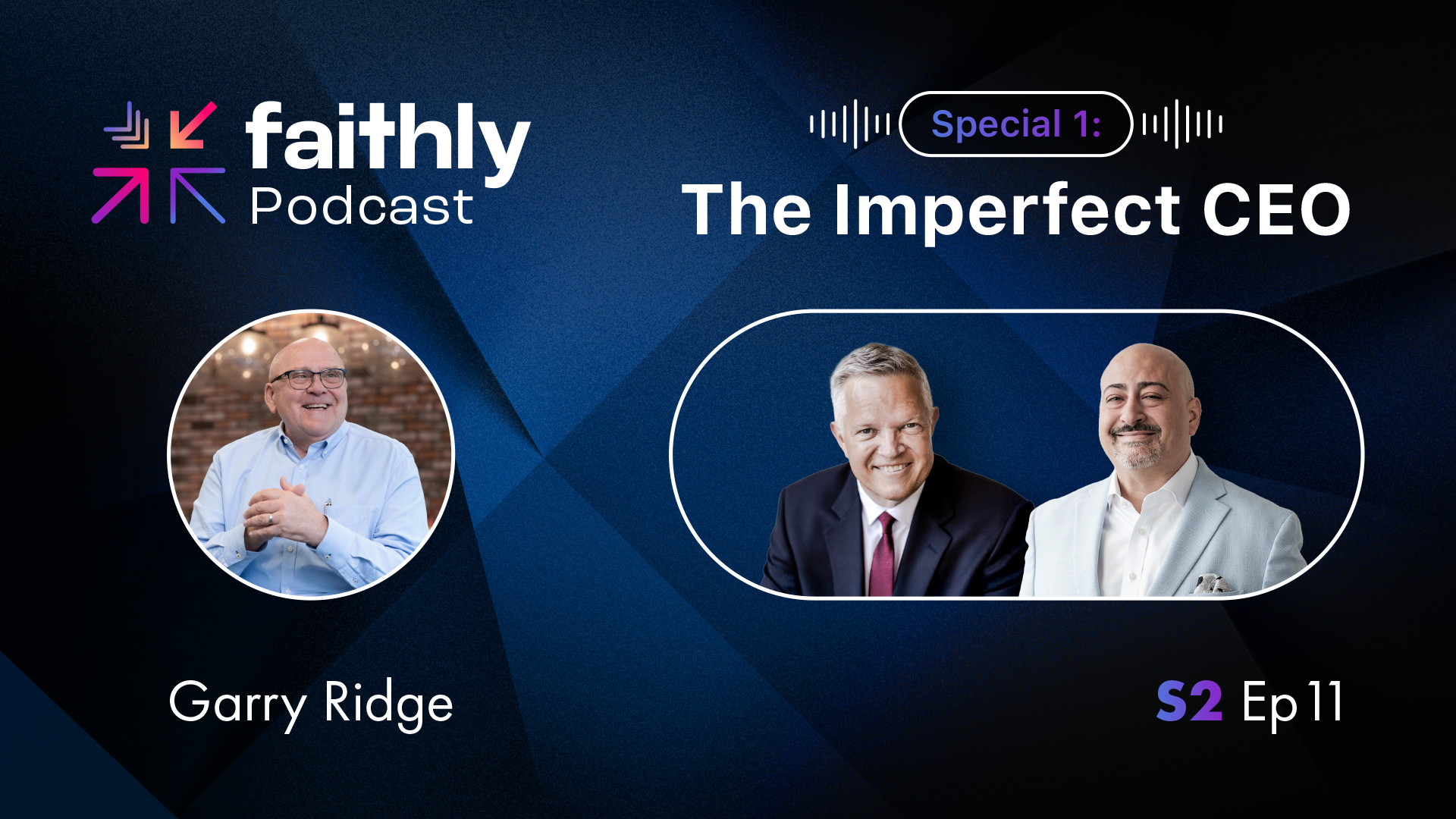
Welcome to The Imperfect CEO, a special series by the Faithly Podcast, where Rev. Adam Durso is joined by guest host Jim Brown—author of The Imperfect CEO and founder of OrgHealth, a firm dedicated to helping leaders build healthy, life-giving organizational cultures.
In this debut episode, Rev. Adam and Jim sit down with Garry Ridge, former CEO of the WD-40 Company, for a candid and deeply practical conversation on what it really takes to lead well. Together, they challenge the traditional model of leadership built on total control and the pressure to appear flawless. Instead, they offer a different vision—one rooted in humility, continuous learning, and a commitment to cultivating environments where people are empowered to thrive.
Drawing from decades of experience, Garry reflects on how WD-40 built a culture centered on trust, psychological safety, and what he calls “learning moments,” while Jim unpacks how many leaders unintentionally become the ceiling of their organizations by trying to carry too much and have all the answers. At the heart of the conversation is a powerful reframe: leadership is not about being the hero, but about creating an environment where others can do their best work.
From honest accountability to servant leadership, their discussion explores what happens when leaders choose clarity over control and development over performance—offering both established and aspiring leaders an invitation to let go of the exhausting pursuit of perfection and step into a more honest, sustainable way of leading.
Website: https://thelearningmoment.net/about/
Connect with Jim Brown, and DM the word “BUILD" at linkedin.com/in/authorjimbrown for a free resource, and preorder your copy of The Imperfect CEO now at http://imperfectceobook.com/
(00:00) When the Hero Becomes the Ceiling
(01:03) Gary Ridge on Donkeys and Humble Leadership
(06:07) Why Imperfect Leadership Matters
(08:43) Building a Learning Culture Instead of Fear
(11:50) The Soul-Sucking CEO vs the Servant Leader
(18:02) The Trap of Trying to Be Flawless
(25:01) When Poor Culture Costs Millions
(28:26) Why Leaders Must Stop Trying to Be Heroes
(34:10) A Message for Exhausted CEOs
(37:42) Final Encouragement to Let It Go
Follow us on social media:
Website: https://faithly.co/
Facebook: https://www.facebook.com/thefaithlyco/
Instagram: https://www.instagram.com/faithly.co/
LinkedIn: https://www.linkedin.com/company/faithly/
X: https://x.com/faithlyco
When you're the hero, that's what your people need, but you quietly become the ceiling of the organization. It's not because you're failing, but it's because you're trying to be flawless. Welcome to the Imperfect CEO, a special series by the Faithly Podcasts with your host, Reverend Adam Durso, and author Jim Brown. Welcome to another episode of Faithly Podcasts. My name is Pastor Adam Durso, and I am the host of today's episode, and I get the incredible honor and privilege to sit here and talk with two esteemed leaders that are doing incredible things, currently and had an incredible history of leading organizations, author Jim Brown, who has the brand new book, The Imperfect CEO. I am joined by you, my friend. Why don't you give a greetings to the audience? So good to be connected with all of you, and looking forward to the conversation that we're going to have today. I'm excited about what the new book is going to do out in the marketplace. And I'm excited because it's just one book in many that are now emerging, that are making everyone pay more attention to the culture and the leadership of companies. Gary Ridge, who I'm excited to be joining our conversation, has also written a great book on this very same topic. Indeed, I would say, Gary, you've been way ahead of your time for decades as you've been a champion of culture and the type of leadership that we're talking about at WD-40 company. Your new book, any dumbass can do it. I like how you say it, that it's the sort of thing that you don't have to be brilliant. A donkey could do this if you just go through the right steps and have the right mindset. So welcome, Gary. Yeah, good day, Jim, and good day, Adam. Great to be with you. Thank you so much. I am the Dean of dumbassery, and it's a pleasure to be with you today. As you just mentioned, my new book, any dumbass can do it. The word ASS is not referring to anybody's bottom wall posterior. It's really talking about a donkey, and you know, donkeys get a bad rap. People think they're just stubborn or slow, but let me tell you the truth. Donkeys are steady. They'll keep going long after others give up. They're loyal companions. You can count on them when the road gets rough. They protect and they're calm, watchful, and surprisingly brave when it matters. They're practical, not flashy. They know how to conserve energy and get the job done. And while they might not always rush into things, that caution keeps them safe. So when I say any dumbass can do it, what I really mean is you don't have to be brilliant to be a great leader. You just need a bit of courage, a lot of care, and the humility to keep learning because like the donkey, leadership isn't about showing off. It's about carrying the load, sticking with the journey, and helping others get to where they need to go. Gary, you led the WD-40 company. Could you give the audience that may not be as familiar with you a little bit of your history and a little bit of your journey, maybe a peek behind the curtain into your leadership that now is producing this new book? Yeah, sure. Thanks for the question. Yeah, I was with WD-40 for 35 years. I started in Australia in 1987. I opened the Australian subsidiary. In 1994, I was invited to move to the United States to head up our International Expansion Program. And then in 1997, the then CEO retired. So for my sins, I got to be CEO. And that was an amazing journey. But the real turning point was in 1999, two years into being CEO, I went back to school. I did a master's degree in leadership at the University of San Diego. And that's where I met my dear dear friend and my mentor, Dr. Ken Blanchard, the one-minute manager. And that two-year master's program was one where I was exposed to the real benefit of servant leadership. You know, leaders are there to serve those they have the privilege to lead. And I took the elements of that learning and implemented it within the company. And I love that program so much. We ended up standing about 30 people over 25 years through that same program. And it was that turning point that really made a difference. In the first chapter of my book, I talk about kind of an aha moment I had. I was on a flight from Los Angeles to Sydney. And I was 38,000 feet above the South Pacific Ocean 2 a.m. in the morning. And as you do, you take stuff to read. And I read a quote that's attributed to the Delay Lama. And it was our purpose in life is to make people happy if we can't make them happy at least don't hurt them. And I thought, what a wonderful, wonderful objective to have if you're leading a company. And then pretty soon after I read another quote from Aristotle. And it said pleasure in the job puts perfection in the work. And I thought, my goodness. If we had a place where we were really wanting to help people are they enjoyed what they were doing. We would be able to build a company that was enduring over time. I didn't know how to do it. And that's when I went back to school. And I learned some of those elements. So then for 25 years, I was CEO and chairman of the board eventually. And I refired three years ago. Not retired. And my purpose now is I hope it is your cultures of belonging where love forgiveness and learning inspire a happier, more connected world because we need a happier, more connected world. Jim, it seems like there's a lot of overlap between what Gary is sharing and what you call the imperfect leadership movement. Talk a little bit about what that means and maybe draw some correlations to what Gary just shared. Sure. My observation is that most leaders in the corporate world, especially, but it's not only that it's it's really leadership in all circles have this sense of pressure of responsibility to show up like they've got all the answers. They know exactly what to do. They're very confident. And they end up carrying all this weight on their shoulders. What Gary just described the idea of make people happy and at least don't cause any harm. That is so counter corporate culture that well, it's just refreshing because most MBA programs would be teaching people that know it's about the numbers. You have to push push push maximize performance, optimize outcome, increase share value. That that language isn't in anything that Gary said and what what he somehow understood all those years ago was if we really lead people so that they enjoy their lives and they can be their best they can be that will make the company prosperous. And it will make everybody happier. It's it's all good. As imperfect leaders, we need to just relax and remember we are imperfect. Everyone is. And if if we're going to be our best, we need to just own our our reality, be authentic. More than ever today, people expect their leaders to show up as humans and Gary did that back in 1999. The idea that we're just catching up to him is a little bit humbling for for most of us. So that's why this conversation is going to be so much fun. Gary's the guy that's been doing it and we're going to learn why he's been doing it at the impact because if it didn't work, he would have done something different by, you know, by 10 years in. No, the truth is it really did work. Gary's company has prospered remarkably and people have loved working for WD for 40 company. Yeah, I mean, Gary, when Jim talks about your leadership and the culture that you both created and sustained, he, I quote, created a learning culture. What does what does that mean, Gary, when you're instituting that in an in an organization or a company? Well, one of the biggest disables people have in life is fear. And, you know, if you think about it, I don't remember seeing many people running down corridors yelling out, I'm a failure, I failed. But, you know, we have this low psychological safety in organizations where people are afraid. So what I said is let's turn failure into learning. So we develop something called the learning moment. And we said that we don't make mistakes. We have learning moments and the definition of a learning moment is a positive or negative outcome of any situation that needs to be openly and freely shared to benefit all people. So if we learned something that was really, really powerful, let's share it. And if we learned something that was powerful, but it didn't quite turn out the way we wanted, let's share that also. So we saved those around us from having the same learning moment. But I just want to go back to something Jim said, Jim, I think performance in an organization is really important. And what I don't want people to walk away with today is this is the soft stuff. What we're talking about is the hard stuff. If it was easy, we wouldn't have 70% of people going to work every day in the United States today, disengaged or actively disengaged. So my theory was if you have a reasonably good strategy and you have a high percentage of your people fully engaged going to work every day, the will of the people as I call it time strategy equals the outcome. So good strategy 80% of your people go to work every day because they're motivated and passionate because they know and feel like they belong. They know that the work they do matters and makes a difference. There's a high degree of psychological safety because learning is at the core, not failure. And there's a set of values that protect them free and their leaders are acting as coaches, not managers, you're going to get a much better result. Then if 30% of your people are going to work every day, it's very simple. And that's why I don't understand why some leaders don't get it. This is, this is an odd door. High will of the people reasonable strategy, great outcome. Low will of the people reasonable strategy, not a great outcome. The math is unavoidable. And yet there's something in the system, in the whole management leadership training agenda that has been going on for decades that has set us up for failure for disappointment. What is that? Gary's holding up a character here. What do you got there Gary? This is this is what's in the system. This is Alec or it could be Alice, the soul sucking CEO of fear incorporated. And Alec or Alice have some leadership attributes that create this. Number one is they have a big ego. Their ego eats their empathy instead of their empathy eating their ego. They're a micro manager. They want to have their fingers in everything. They're corporate royalty. They think they're an entitled leader. I've spent my life climbing this corporate ladder. Those shall bring the coffee to my desk. If you can know unlock the door. They love a fear based culture. They're a master of control. Now what you touched on, Jim, there are no at all. They have all the answers. Even the wrong ones. They don't value learning. They must always be right. They hate feedback and they avoid accountability and they blame others and they don't keep their commitments. That's the problem versus the servant leader and the servant leader loves and involves their people always in servant leadership mode is expected to be competent and they love learning. They're very connected. They spend a lot of time in what I call the stinky locker room of the business instead of some corporate tower. They have a harder goal, but they also have a backbone of steel. Their champions of hope. They know micro management is not scalable. They do what they say they're going to do and they treasure the gift of feedback. That's the difference. Can I ask a question, Gary, when you talk about this isn't just the soft stuff. What was the most interesting or the most difficult learning moment you had to navigate or that wasn't a failure, but it was definitely a learning moment for somebody that was working for you at WD 40. I think there's many. Personally, it was getting very comfortable with the most three most powerful words I've ever learned in my life. I don't know. When I went back to school, I did a disc profile and I was a turbo D and the definition of a turbo D is be brief, be bright, be gone. When I found out what I was, I realized what I didn't want to be. I think intentionalism around leadership is so important. I have people ask this question, am I being the person I want to be right now and who is that person? I have a little notebook that I carry around. I have a little placard on it and it says, am I being the person I want to be right now and then who is that person? I have a list of things intentionally that I want to be aware of. I want to be grateful, I want to be caring, I want to be empathetic, I want to be reasonable, I want to be a listener, I want to be fact based, I want to have a balanced opinion, I want to be curious, I want to be a learner and I want to throw sunshine, not a shadow. I have to remind myself of that because the world will want me to be something different, particularly if you're the CEO of a public company, they will want you not to be who you want to be and we have no right to take our leftovers to anybody, we need to take our full self. Wow, Jim, when you think about leadership accountability and yet you've got to balance it with a learning culture and faucet, especially amongst senior leaders, what does that look like in through the lens of the imperfect CEO? Yeah, Adam Adams referring to one of the peaks that we have in our ascent model leadership accountability, the idea that all the leaders are accountable first to each other and then to the entire company about the impact they have on people about their actions, their behaviors, not just the results that they're getting, of course that matters. But most companies are way more preoccupied with outcomes and under they pay too little attention to the behaviors that contribute. So an accountable leadership team actually behaves in the ways that Gary was describing they use that word I don't know that those three powerful words I don't know without feeling like that makes them disqualified to be a leader. No, it just makes them human and as long as they are going to work together to either find the person in the room that has the answer or find a plan between them to go and get the answer, it's all workable, we don't have to have the answer like that. And as Gary said, it's even worse if you've got an answer and you spout it off with confidence and it's wrong. Wow, now we're really messing things up. Leadership accountability is the humility to say, I'm not perfect. I need people around me because they bring strengths that I don't have. I'm going to bring my best to the whole equation, but I'm not enough. I can't be. So the power of teamwork and then multiply that by 100, 1000, 10,000 people in the company team, we can change the world. The thing that scares me, Adam, is how many of those leaders go home exhausted because they've been pretending to be almost perfect every day. They don't have the energy to be their best at home anymore. They feel like they're always on even when they're at home that they don't really have rest. It makes me think of a client story. I'm thinking of a fellow who was the CEO, founder of a company. It was very visionary, timeless. And from the outside, it kind of looked like that meant the company got momentum. But inside, it was just pressure because every decision bottlenecked at him. People waited instead of leading themselves. One night, he said something that betrayed his problem. He said, I don't trust anyone else to carry this, but I'm tired of carrying it alone. See, that's the trap. When you're the hero, that's what your people need, but you quietly become the ceiling of the organization. It's not because you're failing, but it's because you're trying to be flawless. Most CEOs don't need more motivation. What they need is permission to just lead differently. And Gary's example, I hope, will give more leaders listening right now today. That permission to realize, no, I don't have to do it the way that somehow I was told, I can do this differently. You know, when I was CEO and I used to introduce myself, get out, I'm Gary Ridge. I'm the consciously incompetent, probably wrong and roughly right. Chairman of C&C of WD-40 company, and I need all the help I can get. And it's amazing how much help you get. And that's the way, and I'd often say, I'm probably wrong and roughly right. I'm never 100% wrong, and I'm never... Well, I probably was 100% wrong. Gary, when you're in a learning culture, you're creating this, and there's obviously a need for accountability, especially as you get closer to senior levels of leadership. How do you discern and differentiate between impact and intentions? Well, I think firstly, around accountability, are we clear about what we're holding ourselves accountable for? And I think clarity is so important. What do you expect from me? When do you expect it and to what standard am I to deliver it? And I wrote a book with Ken Blanchard called Helping People Win at Work. And the byline is, I'm not here to mark your paper, I'm here to help you get an A. So the next question is, do people know what that A looks like? If an A walked in the room today, what would it look like? Then our job as leaders and coaches, not managers, because I really don't like the word manager, you manage your bank account and you manage inventory, you don't manage people, your job is to coach them. So your job is to help those you have the privilege to lead and coach, get the best outcome. So a great coach is committed to helping a player get an A. Importantly, they're brave enough to put the players growth ahead of their own comfort. They know the game, they know the standards and what winning really looks like. They stay on the sideline, resisting the urge to jump in and take over. They observe first, listen deeply and watch how the play unfolds. They add value through timely, honest feedback that helps the player improve the next play. They expect the player to apply the coaching received. They never seek the podium or credit for the win and they invest time in what I call the stinky locker room, building trust, safety and belief in the organization. So I think there's two things. Is it clear? And then what are you doing to keep people on that track to win the best game? Jim, in your book, the imperfect CEO, you give a formula for success. Culture times strategy equals outcomes. That's not mine. No, that's not my formula. That's Gary's formula. That's Gary's formula. How has in my book because he told me that wonderful formula. And I love it. And that's fantastic. So Jim, elaborate on that. How has Gary's formula impact your leadership? How you confession confession? I stole the formula from Simon Sennick. Oh, you know, in Simon's book, he said culture equals values plus behavior. And I said to Simon, Simon, you forgot a word consistency. So now culture equals values plus behavior times consistency. So this formula has been ginned up by a lot of people. Well, I just love in the honesty on here because most podcasts somebody would have just said, ah, that's me. And the bottom line is we're all giving credit to somebody else for the same exact quote. So Jim, you read it and got it from Gary, but it's had an impact. It's it's shaped the way you do some of your leadership coaching and those kind of speak to that. Even how it's impacted your writing in the imperfect CEO and the imperfect CEO leadership movement. Yeah. So again, the old model of leadership has been so focused on strategy like if we just get the right strategy, we're going to win the world. And there's been very little attention to culture. What I love about that formula. Not let me just let me just also say I love that we stand on the shoulders of the people that go before us. I'm standing on Gary shoulders. Um, Gary's standing on Simon's shoulders. It's not about age. It's about who who came up with something that's working in lets us win. Well, let's let's all take it on. And I know Gary isn't trying to own it. He would he would like me wish that every CEO would grasp us and make it their own because if we don't make culture, a central piece of how we aim for our companies to be successful. We're just going to be going in circles. It's it's the math that Gary shared earlier. If if 70% of our people are disengaged because they don't feel valued, they're not sure that their strengths matter. They don't even know if the job they're doing makes a difference in the world. Then it doesn't matter how much effort they put in because it's not taking them forward. It doesn't matter how good the strategy is because they're not bringing their best when they see something that is probably going to be a problem. They don't say it. Adam, you may remember one of the terrible client stories that I shared in my book was about a leader who instructed someone to put certain chemicals in a big storage tank. And it was the guy that did it knew it would destroy everything in that tank. But he quote followed the direction of the leader because it wasn't safe for him to challenge the leader and it cost millions of dollars. These kinds of things are happening in companies all around the world. Imagine what is possible. Imagine the level of prosperity and impact in the world that's possible. If we actually valued people so that they could be the best that they can be. And that all contributes to the impact of the company. Definitely. We had 98% of the people at the company globally said they love to tell people they worked at the company. We had a 93% employee engagement. 97% of our people said they respected their coach who was their quote unquote manager. Most people leave organizations because they hate their boss. And by the way, we had a compounded annual growth rate, a total shareholder return of 15% a year and the value of the company went from 300 million to over $3 billion. So again, we proved that our strategy was a reasonable strategy that the multiplier was the culture. Because people, you know, often say imagine a place where you go to work every day. You make a contribution to something bigger than yourself. You learn something new. You're protected and you're set free by a compelling set of values. And you go home happy. Happy people build happy families. Happy families build happy communities. Happy communities build a happy world. We need a happy world. Business has a responsibility and an opportunity to make a positive difference in this unhappy world that we're kind of having to deal with right now. If we just send people home happy because they felt like they belong, they mattered, the things that I've shared. So, you know, to me, it's like all duh. So you said you references before Gary said, you know, to the people that think this is just the soft stuff, the people that think this is just fluff. There's really a direct correlation between the health of the organization and the bottom line. Absolutely. And Jim, so when you're coaching organizations and you're helping to lead this movement, how are you positioning or describing the correlations so that that leader understands, yes, you're accountable for the growth of your organization. Yes, the bottom line, but there is something in this and what we're talking about that has a direct impact on your success as a leader as a CEO, et cetera. One of the most surprising problems that I observe as I work with leadership teams of companies, whether there's 200 people in the company or 20,000 people in the company is how tempted these leaders are to try to become recognized as heroes. And they do that by focusing on outcomes and they're doing rather than their leading. And what leadership is supposed to be about is serving, I even use the word loving people so that they can be their best. Again, if I've got 200 people in my company, it doesn't matter how many hours I work and how hard I work or how smart I am, I could never be as impactful resourceful, fruitful as 200 people. My job is to make it easy for those 200 people to be the best they can be. That's where results come. That's where multiplication comes. So the CFO, and I've seen this over and over, who is looking over the shoulders of someone on their finance team, who's entering numbers into a spreadsheet and the CFO just can't stand it says wait and pushes their chair out of the way and type something into the spreadsheet themselves. They've just told that person on the team, you're not really that good. I'm way better than you are. You shouldn't really even worry about it. I've got it. Those people go home and they wonder if it's worth coming the next day. But they need to pay their mortgage so they come, they show up, they get paid, but they don't bring their best. They just show up and punch the clock. Leadership is about making it so people, and I sometimes I say this and people think I'm imagining crazy, impossible things. People like their job so much there, they can't wait to get there the next day. Because they believe that it is the expression of what they were made to be. It is the opportunity for them to bring their gifts, their strengths, and do something that matters in the world. And better than that, they're surrounded by people who are doing the same, and all of that comes together and we're a part of something that's way bigger than I could ever be. Again, Gary, please help the leaders who are listening, who are scared that that is pie in the sky. Help them hear how you saw that happening at WD-40 company. Yeah, we saw it happening because firstly, we wanted to place where people escape too, not escape from. And I wrote about that in my book, is that, you know, many people would say to us, I want to be here because I feel valued. And maybe they weren't valued in their personal life. But you know, there's four pillars that I talk about that are in place. They're care canter accountability and responsibility. So pillar one is we love, and I use the word love, we love and care about our people enough, not only to reward and applaud them for doing great work. But we're brave enough to redirect them when they're not playing for an A, not protecting our own comfort zone at the expense of someone else's growth. And you know, people want to be directed to play well. Can there is no lying, no faking, no hiding. I believe most people don't lie in organizations, they fake and hide. Why do they fake and hide? Because of fear. Because you've got, you know, Alec or Alice, the soul sucking CEO who can never be challenged and doesn't want to hear another opinion. Accountability, are we clear? What do I expect from you? What do you expect from me? And how do we bring those two together? And then finally, responsibility, you know, responsibility equals accountability and ownership. And in fact, we had something and they still have it at WD 40 company. And I call it the vaccination against the na na na na disease as I called it, the finger pointing disease. And we call it the maniac pledge. And it says, I am responsible for taking action, asking questions, getting answers and making decisions. I won't wait for someone to tell me if I need to know I am responsible for asking. I have no right to be offended that I didn't get this sooner. And if I'm doing something others should know about, I am responsible for telling them. So those are the things that you put, you put permissions in place in organizations that allow people to be who they need to be. Jim, we've talked a lot about the senior leader, the imperfect CEO and their impact on subordinates or impact on the people working for them. Then potentially not bringing their full self to the table them being miserable or and so as a result, not being as productive. But the people that might be watching or listening to this podcast, who are CEOs, who are in top to your senior leadership level positions, who are just exhausted and tired of trying to hold everything together and pretend like they've got all the answers. What do you say to them and what would you help them to be able to take away from this podcast and really adopt into their learning. I know I know you worked on this. You've got something special for some of those leaders who are even listening right now. Exactly. What I do with my private consulting clients is talk through the kinds of impacts that they're having, that they're the choices, their behaviors that they're exhibiting or having on people and help them recognize that all of that can change if they make some changes. See, it turns out that in most cases, the limiting factor of an organization's growth is the leader. And if they would kick the ceiling and push up everything gets better, I have something that I called the imperfect manifesto. So I have these conversations with these leaders and then I share this document that just kind of wraps it all together. It's, I don't know, eight or 10 pages. It's not a huge thing. As we're listening today, I'm conscious that there are people who are wondering to themselves, oh, might they be the limiting factor in their organization. And as much as I want them to read Gary's book, I want them to read my book, these people need something right away. So what I would like to encourage them to do is find me on LinkedIn at author Jim Brown. That's, that's my handle. And DM me the word private, P R I V A T E, I'll send that manifesto to them so that they can just get a quick tool to actually make a difference right away, something practical to work with immediately. Again, at author Jim Brown on LinkedIn and send me the word private. And you'll personally send the imperfect manifesto to them for free. Absolutely free to help them right now and it'd be better. Yeah. This is just normally reserved for your private clients, what you're doing this for free to help these CEOs and leaders. And then the book is the imperfect CEO book. imperfect book CEO in perfect CEO book.com. I'm sorry Jim. I'm sorry Jim. I'm going to that site. Yes, there's there's a package. There's several packages for them to to buy bulk orders before the release imperfect CEO book.com. And there's incredible bonuses that we've provided so that as for example, if people say, yeah, I'll get 10 books so that the people closest to me each get a copy. That's $500, but they ended up getting like $3,000 worth of bonuses. It comes back to what you've been saying, Gary, it's like a how does that not make sense, but my encouragement is that people would order books, but like I said, if you want something right away, send send me that message and we'll get you a resource immediately. At author Jim Brown on LinkedIn and just send the word private and we'll get that imperfect manifesto out to you. Gary to those to those CEOs and leaders that I just described and Jim just addressed, what would be your closing thought to them that are struggling that have to feel like they've got to put up this facade this front that says I know it all and it really has become the limiter and the lead to their organization. What would you say to them in the next 30 to 45 seconds to encourage them let it go let it go and I'll offer something as well. I feel like the theme from frozen should be in the background while you're while you're doing that, Gary. Go to my website, www.learningmoment.net and take the dumbass quiz. And if you take the dumbass quiz, you'll get a score of dumbassery out of 100 and then I'll also send you automatically a little workbook of what are the things you can think about to let go of that that crown you have and to become a scholar of dumbassery or join the school of dumbassery that I have on LinkedIn. So where we teach the power of dumbassery. I feel like I've already part of that school and I haven't taken the quiz yet. Gary saw I'll sign up for it and Jim thank you again for the imperfect manifesto and providing that Gary. Thank you for all the tools this conversation has been absolutely fantastic Gary Ridge Jim Brown. My name is Adam Durso and this has been Faithly Podcast. Thank you for joining us follow us on all the social handles and the description in the bio. Have a great rest of your day and lead well.