

 Amazon Music
 iHeartRadio
 Apple Podcasts
 Spotify
 Pandora
 YouTube
 The State of Theology - Chris Larson | Faithly Podcast
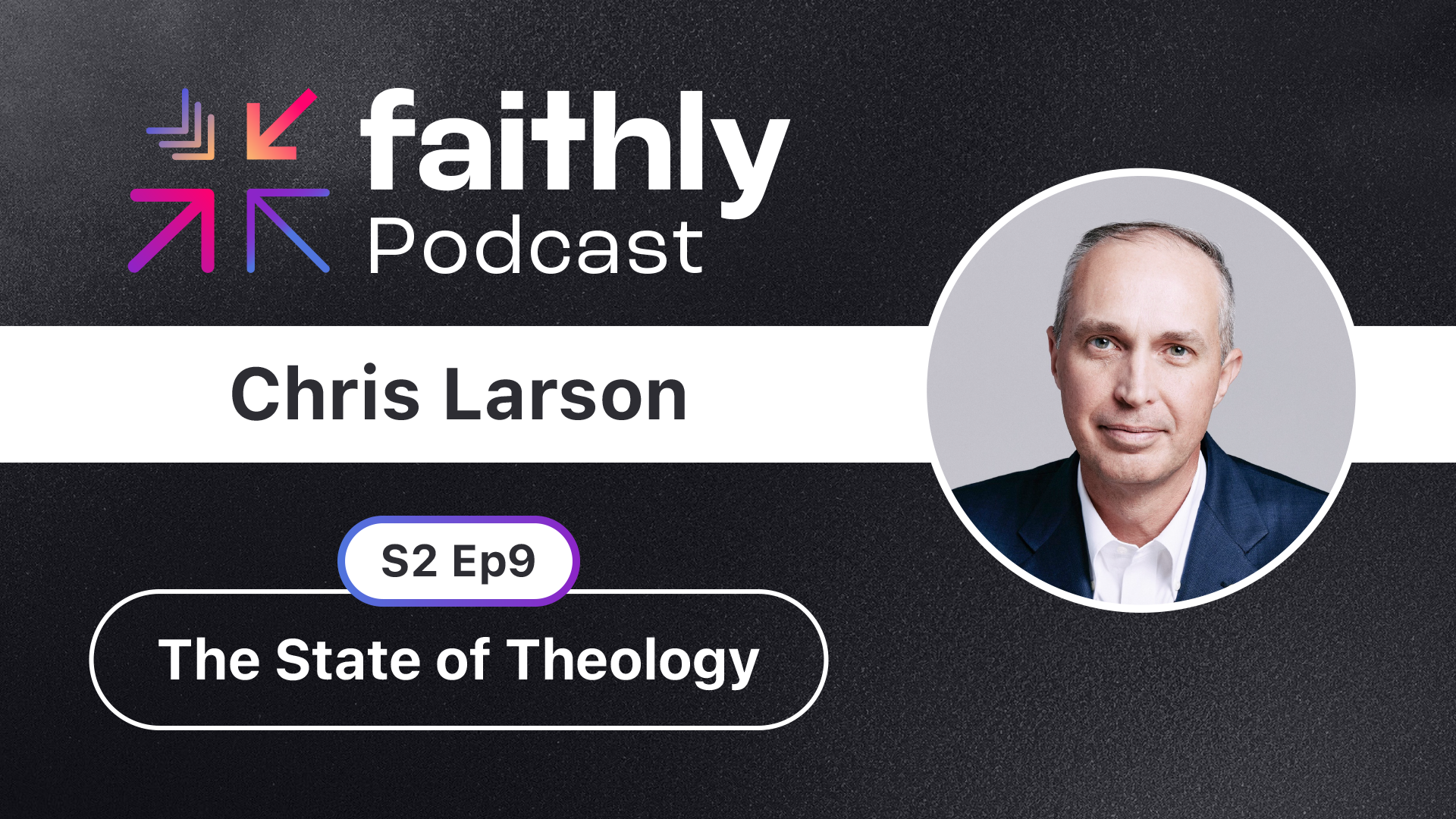
In this episode of the Faithly Podcast, Alicia Lee is joined by Chris Larson, President and CEO of Ligonier Ministries, for a thought-provoking discussion on the findings of the 2025 State of Theology report and what it reveals about the beliefs shaping today’s church.
Drawing from the survey’s results, Chris explains how many American evangelicals are wrestling with confusion around foundational doctrines—including sin, salvation, the Trinity, and even the uniqueness of Christ. While the data reveals surprising contradictions in what many believers say they believe, Chris helps unpack the cultural forces contributing to this trend, from growing pluralism to widespread biblical illiteracy.
Together, Alicia and Chris explore why theology matters for every believer, not just pastors or scholars, and how our understanding of God inevitably shapes every aspect of how we engage the world around us. Despite the challenges the report highlights, their conversation ultimately points toward hope, extending encouragement to churches and believers to lean into clearer biblical teaching and authentic Christian community—trusting that God continues to build His church through the faithful proclamation of His Word.
Website: http://www.ligonier.org
(00:00) Introducing the State of Theology Survey
(01:20) Chris Larson’s Journey into Theology and Ministry
(06:30) The Mission of Ligonier Ministries
(10:50) Why Everyone Is a Theologian
(14:00) What the Survey Reveals About Evangelical Beliefs
(17:30) Confusion About Sin and the Need for the Gospel
(19:40) Misunderstanding the Holy Spirit and the Trinity
(21:30) The Rise of Universalism and Cultural Pluralism
(25:00) The Importance of the Local Church and Discipleship
(31:10) Confidence in God’s Faithfulness to Build His Church
Follow us on social media:
Website: https://faithly.co/
Facebook: https://www.facebook.com/thefaithlyco/
Instagram: https://www.instagram.com/faithly.co/
LinkedIn: https://www.linkedin.com/company/faithly/
X: https://x.com/faithlyco
This pluralistic idea has really seeped into the church and there are churches that are not real clear on this. I mean, I hear these things from movie stars and politicians and pastors. This is the Faithly Podcast. Every couple of years, league in your ministries does this partnership with lifeway and you all release the state of theology, which is a survey that explores what Americans believe about God. And the 2025 findings, the most recent findings were fascinating because it revealed that the majority of evangelical Christians in America have views of God and of sin that contradict Scripture. And so I'm joined today by Chris Larson, President and CEO of league in your ministries to tell us a whole lot more. Chris, thank you so much for joining the podcast. It's great to be with you all and to discuss these matters and we look forward to this conversation and anyway, we can serve your audience. Wonderful. Wonderful. Well, thank you again, Chris. Before we dive in to this important report, I'd actually just love to start with your personal story. You didn't begin your career in ministry. In fact, you worked in the educational and the corporate world. What was the turning point that led you into ministry? Yeah, I would say that from the time that I was converted late in my teen years, I was early disciple by a gentleman in my church who was answering all those questions that Christians have in their early 20s or late teens early 20s. That's God's will for my life. What am I supposed to do for for a living? Who am I supposed to marry? All those big God's will questions. And I didn't know hardly anything about theology at that time. So he kindly discipled me, helped me to understand the scriptures better. And he took me to the call of Abraham in Genesis 15. And I won't go into the longer story there, but it is important because it does relate to my work, even at Ligonier, that what God came to Abraham with was a promise. Abraham believed that promise and it was counted to him as righteousness. But even Abraham's faith wavered. And he was asking, how am I going to know how all these things are to be? And the Lord graciously made a covenant demonstrated that covenant in a rather strange ritual. And your viewers can go and read about that. And even in Genesis 15 verse 17, you see this picture of the Lord God going through this covenant ceremony, where typically the repeat parties on both sides of a covenant saying, I will do this. You must do that. And if we don't hold up our end of the bargain, then may what's happened to these animals that have been sacrificed here. May that happen to, you know, the covenant breaker. And amazingly and graciously, God is the one who himself guarantees both sides of the covenant in that beautiful, beautiful episode there. And my friend took me there. And he was trying to say, listen, it's not about the strength of Abraham's faith. And it's not about the strength of your faith, Chris. It's about the object of your faith. God has promised. And according to his character, he will not lie. And because he is sovereign, he's powerful. He can guarantee the very ends that he is using means to accomplish. And Abraham's faith was imperfect. My faith is imperfect. I send daily and word thought indeed. And yet God, because he is sovereign. And he's a person. And he's a covenant keeping God. My friend is just helping me to say, this is who you can trust. And I think that is what wet my appetite for theology, because theology is nothing more really than just knowing who God is. John Calvin would talk about how we can't really know who we are unless we know who God is. And so to have that self knowledge requires knowledge of God, a right knowledge of God, and then how we're to live in this world. And of course, our need for our faithful savior, Jesus. And so that's a long way around for me to say that I always had in since early days of my Christian life. And orientation towards the church and theology. And even in the more corporate type of settings, I had an eye towards the local church and trying to serve the local church in some way. And then by God's grace. So the other funny part of that story is my friend who is discipling me. He's taking seminary classes from Dr. R. C. Sproul, who founded Ligonier Ministries. And I didn't know anything about who R. C. Sproul was at that time, but I quickly learned. And so I just began to discover that there's a whole ocean out there of theology that I didn't even know existed. It's almost like Lewis and Clark going across America and discovering the Pacific. Wow, there's an ocean there. That was kind of what my experience was like and discovering theology and the historic Christian faith. So I hope that answered your question a little bit. I've always had that orientation. Yeah. And it is a beautiful response. I heard you very clearly say you've always been serving God. You've always been serving the kingdom and leading Ligonier is really just the next step in a career that has always been oriented towards God, even when you were working in the corporate world. That's right. And I didn't feel the call to preach. I did attend seminary. I became an administrator in the small seminary. And it was really there that I was refined in my own sense of vocation and calling and recognize that there are people who are called to preach. And while you might have external gifting, if you don't have that sense of internal call that this is what I must do, you should probably pursue some other paths until the Lord makes that a little more clear to you. And so by God's grace, I think the reformation gives us a lot of insights in terms of the doctrine of vocation and seeing how that can apply to so many areas of life. That's so good. Well, so you mentioned the founder of Ligonier RC sprawl. He founded the ministry about 50 years ago to proclaim, to teach and to defend the holiness of God. Chris, as you've carried that great mission forward, how have you discerned what faithfulness looks like in this generation? That's an amazing question, Alicia. So faithfulness is success. I think that that is what the Lord honors. The Lord honors those who uphold his word and do not defect from it. And so in a time where things are so confusing and sometimes vitriolic out there in the culture, I think being able to provide words of truth, seasoned with grace, spoken in love, and remembering that speaking the truth doesn't necessarily mean withholding the truth. You have to speak it in love, but not withhold the truth. And so I think being able to be courageous and convictional, not wavering and recognizing that the old paths, as Jeremiah says, the old paths are paths of life. And so there is an era of novelty. There's an era of AI generated falsehood and deception. And I think that's only going to get worse for all of us. So being able to help the next generation think through, how do you discern truth from error or even more problematically, truth from half truth? And that's probably the more important area of discipleship that we all must be focused on. Well, so say a little bit more about that because so one of the things that I admire very much about league and year is how you all make rich theology really accessible through multiple channels table talk magazine, renewing your mind, refnet reformation Bible college. What's guiding your vision for discipleship in a world that's flooded with information as you say truth, half truth, and just so much information, right? Yes. Well, Dr. Sproul, when he founded the ministry, he was very intent that this is about a message, but it was always a methodology as well, because he taught at the seminary level, but he, because of his work in the local church, quickly discerned that he had a greater interest in focusing on lay people and helping men and women and boys and girls to be able to understand the riches of the Bible. And the theology of the scriptures and trying to help them to understand how that applies to your daily life, but he wasn't a pioneer in one sense, because Martin Luther, this is exactly what he did during the Protestant Reformation. He took the message to the people and you had the advent of the Gutenberg printing press and all the technological innovation that that happened in the 16th century. And so RC, he applied video back in the 70s, which was at that point really cutting-edge stuff. In fact, the ministry would distribute VHS tapes to churches for their Sunday school and training programs. And some of these churches didn't even have VHS players. And so the ministry would just give the churches VHS players so they could play the different tapes. But the recording the series, the holiness of God, it's gone through several iterations, later the book, the holiness of God, it's really come down to that unchanging focus. And I think that that's why Ligonier has just been able to stay grounded and focused on its mission. And when we talk about the holiness of God, it gets back to that idea of really knowing who God is as he's revealed to himself through all of scripture. Wow, that's so good. I want to talk about RC again. Something that he's known for saying is everyone is a theologian. The question is whether you're a good one or a poor one. I'm curious your thoughts on that. And why it has resonated so deeply for so long. Well, let's go back to where we are right now, just sociologically, culturally, politically, even in the church today. There's so many different ideas and we talk about the marketplace of ideas out there. The reality is that there's a lot of prescriptions for how to fix people, how to fix society, how to fix our politics, how to fix our economy, how to fix our families, how to fix the next generation. But what many, not just Ligonier and not just Dr. Spul, but many in the church have observed is that these ideas are profoundly theological. In other words, who we think God is, changes who we think we are. And so you have to get to know the scriptures, even just answering the question, who is Jesus? That is a theological question. And it has to be the scriptures that speak. And this is where we want to just help more people to know. And I think the challenge that we're all facing in the church today, I'm sure many of your viewers and listeners would appreciate is that there is a biblical illiteracy out there. And that people actually just don't even know what the Bible says. And so there's a pressing need for all churches to be leaning into just how do we help the next generation? How do we help our neighbors? How do we help our co-workers to know what's in the Bible? And the Bible can speak for itself many times. We don't need to be the interpretive layer. And so the scriptures speak authoritatively. Well, that's actually a great segue into the next part of the conversation I want to have, which is about the report. How did it start? And what does Ligonier hope that the church will take away from it every couple of years? So we began back in 2014 and it was driven by this idea that everyone's a theologian, but not everyone's a good theologian. And it matters profoundly what you think about who God is, but we look at a doctrine of God, Jesus Christ, Holy Spirit, sin, salvation, and a range of different ethical issues that have come up. And we have the idea to create a longitudinal study. And so that's why we come back around to it every few years to be able to track trend lines to be able to provide a resource to the church. Lifeway research has been a great partner for us and they they do a great job of running this panel. It's a thorough panel 3000 different respondents coming into this. I mean, most of what we see on the nightly news in terms of survey this or survey that is usually a thousand people are less. So it's a rigorous sample size. While we're trying to take the theological temperature of the US population at large, we are really trying to focus in on the church. And so that's why in our findings, that's what we're really trying to focus people's attention on is some of the the confusion in the church. One of the things that RC would say is that Christians many times have happy inconsistencies and what they believe. And so what you would need by that is on the one hand, you may have a very orthodox understanding of the doctrine of God, Jesus Christ, sin, salvation. And yet in other areas, you can have discontinuities as well. But that shouldn't surprise us either because the work of discipleship is a lifetime process being justified is a once and for all moment in a Christian's life, but the process of sanctification of having our minds renewed. That is a lifetime process. Some people seem to accelerate and I look at them and I'm like, wow, I wish that I could be more like them. But day by day, the Spirit of God is working in us as we're looking at His Word to renew our minds so that we're not conformed to the pattern of thinking that's in this world. Sorry, I'm quoting Romans 12 to you. I love it quote, quote, away, Chris, I love it. Well, so I want to I want to mention a couple of specific examples of the statistics that are coming out of the survey so that our listeners have a really concrete idea of what we're talking about. So this year's report found that over 60% percent of evangelicals believe everyone is born innocent in the eyes of God and over 50% believe that most people are good by nature. What do those percentages? What are those findings tell you about how well the church is teaching or maybe not teaching about the doctrines of sin and of grace? Yeah, so you can share in this some of the problems if we have a deal to reach the gospel and share the gospel with our family and friends and our neighbors. If we believe that people are by nature good or that having the other phrase go here, everybody's born innocent. So if everybody's born innocent, do we need Jesus? Do we need the gospel? And so that's just a sandpaper moment for the church to be able to say how we've got to make it perfectly clear about the nature of humanity that we are fallen from birth and that we are in need of a savior. And so we wanted to say kind of away with this universalism which can sometimes just be more like a soft universalism everybody's good just be sincere and whatever you believe and it seems like it's invoked today to be spiritual but not religious. Really that seems like we're just creating idols that were then serving and not the biblical God and not understanding the biblical doctrine of salvation. So I'd say one of the main efforts for the state of theologies provided discipleship tool to the church so that they can then help their people to better understand why these things are important. And so I've heard of a lot of pastors who'll just take this survey and they'll do a short little series and just make sure that are we good on these things because we have new people coming into our churches all the time, particularly these days, whether it does seem to be a renewal of interest and spiritual matters. Well, we want to be able to just help people understand here's what the scriptures say and so we have to take them a little bit more deeper into the scriptures and just kind of clear up some of the cobwebs too. But sometimes people just been poorly taught and they just need good discipleships so here's the strong churches. Well, so that is a great idea to take some of these findings and then to check in with the congregation. I think sometimes it's not even necessarily about the wrong teaching but rather some things just don't get taught. There's another stat from the report that was really interesting to me it said that over 50% of evangelical said the Holy Spirit is a force but not a person. Why do you think there is so much confusion about the personhood of the Holy Spirit? Well, I think that we can be understanding on the one hand because there is mystery in the doctrine of the Trinity. And yet maybe some teachers and pastors they've just shied away because maybe they don't feel like they've got a full handle on how to present this. And so I think that there's a lot of resources out there to help with. Ligonier can certainly help with that but the reality is that we have to have a right understanding of one God, three persons. And this is how he reveals himself to be through the scriptures and otherwise we're walking around with Star Wars theology in our head thinking that there's some mystical force out there guiding and shaping things. The Holy Spirit is a person. We can sin against the Holy Spirit. You can't sin against the wind which is a force or gravity. Maybe it's a better picture. Well, so there was a word that you used in one of your responses. You said universalism or a soft universalism in the report. It said that half of evangelicals agreed that God accepts the worship of all religions even while affirming the Bible as their highest authority. Is that an example of universalism? It certainly is. And again, you kind of hope that maybe they misunderstood the question in some way. One hopes that because that's pretty shocking. It's horrifying really. This pluralistic idea has really seeped into the church and there are churches that are not real clear on this. And again, it gets back to doesn't matter what you believe as long you believe it sincerely. I mean, I hear these things from movie stars and politicians and pastors. And I think this is a unique challenge here for American Christians as well. I'm in Asia, occasionally South America, other parts of Africa from time to time. And maybe I don't hear quite as much universalism in the church. It seems like in other places where persecution has been a little more sharp people know better what they believe. I think we've we've been coasting for a while in the evangelical church and the state of theology surveys, a bit of a wake up call we hope to care about the theology of the scriptures and to understand that these things are not just some academic knowledge trip, where it's just you got to get the right answers on an exam. That's not it at all. These are matters of eternal truth, eternal heaven or eternal hell in many cases. You don't mince words in your report, Chris. You wrote poor theology, no matter how sincerely help can lead to confusion, compromise and even spiritual harm. Can you talk more about the consequences of everything that we've been talking about? I think if you look at a number of trend lines in the mainline churches and some of the different schools, seminaries, things like that over the past 30, 40 years, I think you can see just that decline. I was just looking at some reports the other day putting out by a statistician who reports on these things and it's very clear that as a church defects from the historic Christian faith, there is a weakening and a softening. And so many times if we're not discipling our people, they're not able to then discern falsehood, they're not able to discern, as I was saying earlier, truth from half truth, not just truth from error. And if we're not doing that work of discipleship, we just make our people vulnerable. And so I think this is the time, as I said, I think it's a wonderful time to be alive as a Christian. I think it's an amazing time to be able to witness for the gospel, to be able to see the great commission go forward. I believe that the church is growing, but there are pockets where we could shore up our theological understanding derived from the scriptures so that the church is healthy. That's what we're talking about here is we want to see healthy churches. So that's the vulnerability that we're trying to get at and just sound an alarm. This is a concern. This is the caution. On the state of theology website, churches can go into a data explorer and see all of the information there. If you go into different regions, you can sort by age, you can sort by various sociodemographic layers there, college education, household income, ages, of course, male, female, but you also look at different regions of the country. It's a way for you to be able to give people your own test so you can actually send out to your small group or your church a test and it anonymizes the responses. But it's a way to just say, are we good here? How are we doing? It's a nice little temperature check for churches. And so a lot of people are using this anonymous group survey tool. Can they find that on your website, Chris? Yes, it's on the state of theology.com website. Okay, great. Perfect. Many of the survey findings that we've talked about were very surprising to me. Here's something that being in New York City actually did not surprise me. This survey result. It said that only 61% of evangelicals believe every Christian has an obligation to join a local church. Why do you think that commitment to the local church is weakened over time? And how can we recover that biblical vision for belonging? Absolutely. Well, I do believe that the scriptures teach local church membership. Otherwise, church discipline has no real context. If you look at Matthew 18 and other passages in the scriptures, how would you exercise church discipline if there's no actual membership in a local body of believers? So just logically, you know, they're just needed to be some teaching there. But I think part of the challenge here is that we are in a transient culture. If you're there in New York City, I mean, people are coming in and out all the time, right? And people are so busy. And sometimes we've allowed that busyness to happen to us. And along with the decline of church membership is just kind of the general decline of seeing the Lord's day as important. That one day and seven pattern of worship and rest that the Lord said is sacred and should be set apart. It's a gift to us to recover an understanding of the Lord's day, to lay aside our worldly employments and to be engaged in the worship of God, the fellowship of the saints. We need this more than we know. And we are all stressed out and tired and so much stuff is bombarding us. The Lord gives us 52 days a year to rest, to take a break, to turn off the phone, just give it a rest, be with God's people. And so again, I think in this age of technology and the AI world that we're all kind of grappling with now, being embodied in a community, I think people are going to see the value of this even more so. And so I'm actually quite bullish on the local church because I think people are going to recognize I need community, I need accountability, I need encouragement. And I'm not sufficient in and of myself like I need spiritual authority in my life, I need my brothers and sisters encouraging me and godliness and holy living. And I'm not an island unto myself. And the devil I think likes to isolate Christians and let them live on social media, kind of peering in on other people's lives, but they do it from the safety of behind their screens. And they're just living these isolated lives and the devil just loves to wreak havoc on us when we are cut off from the body. So I mean, you have all these beautiful images and scripture, don't you have the shepherd who goes out to find the lost sheep and to bring it back into the flock. Well, we're the sheep Christ is the shepherd. So let's let's stay in the fold. So I think the local church is essential for the health of the progress of the great commission. Yes. Yes. Amen. I couldn't agree more Chris. Very well said. Thank you. So let's wrap it up on the survey with this question. The survey clearly isn't just about diagnosis. Ligonier wants to provide solutions and you've talked a little bit already about how pastors might use this survey in their teaching and in their discipleship. Is there anything else like a 10 small groups use it other church leaders. What else is available to them from Ligonier or from other places to disciple their people more effectively and sound doctrine. So the state of theology dot com is a good resource to be able to go through some of these questions. We provide some answers that give you scripture versus to be able to teach through these different questions. We can use the groups survey tool. But then we we have to recognize that yes, everyone's a theologian and Ligonier provides a free electronic copy of Dr. Spreld book called everyone's a theologian. And so that'd be a great opportunity. You can do that right there on that state of theology website. But Ligonier Ministries, we think of ourselves as a Monday through Saturday ministry, Christian discipleship, because we want people to be in the local church hearing from their pastor on Sundays. But many times we just need theology on the go. And so being able to listen to good faithful podcasts, ways to be able to get into the scripture each and every day to have our minds renewed. We have conferences that we host around the country, focusing a lot even in recent years on teenagers and helping them to think through some of these questions as well. So hoping to maybe bring something to New York City in the next year or two. So maybe yeah, maybe see you there. Yeah, keep me posted a lot of our listeners and a lot of our community members are here in the New York City area. I think that could be very interesting. We're always looking for more resources on how we can better the church and better disciple. Not just adults, but young people as well. Let me ask you just one final question, Chris, which is this. You said you're optimistic about the church in all of these findings and all your conversations with churches and pastors. What is making you optimistic? What are you the most optimistic about for the church now and the church of the future? Maybe I'll just go back to what I was telling you in terms of my own testimony there at the beginning of the Lord is faithful. He's promised to build his church. He says in the Great Commission, I'm with you, given to the very end of the age. He'll never leave us or forsake us. So my confidence is not in our own ability, our own strategies, our own resources. My confidence is in the Lord and the church will go through tough times, you know, go through times of great blessing. And you can see that across millennia as the church has waned and waxed in different eras. But we always know that the renewal comes through a renewal of the truth and the confidence and the word. You see that in Old Testament Israel when Josiah finds the scriptures and a revival breaks out. This is what we long to see a revival drawn really from the pages of scripture as the gospel is preached clearly. And I do see pastors growing in confidence in the gospel and not trying to come up with some new strategies and methodology. Sometimes it's just standing up there and just being very clear about what the scripture says and having the confidence to say, thus says the Lord. We need that today. And here's my confidence because I know the Lord is faithful and know that his word is powerful that he is sovereign because he is so kind and gracious. His sheep hear his voice. And so we just have to be faithful messengers and the state of theology survey is just trying to urge us to be more faithful messengers of the truth because Christ sheep will hear his voice. They will respond. They will want to come and defeat and to rest and to drink by the cool waters. That's the gospel hope that we have and we have no other hope. Thank you, Chris. That is a good word that I heard today. Really appreciate your time, sir. Thank you for sharing all of this with us. And in the show notes will be sure to link to Ligonier and to the state of theology website and the report so that all the pastors and other ministry leaders were tuning in can tap into these amazing resources. I appreciate being with you so much. Thank you for the opportunity. You