


Special 4: The Imperfect CEO - Stephen M. R. Covey | Faithly Podcast
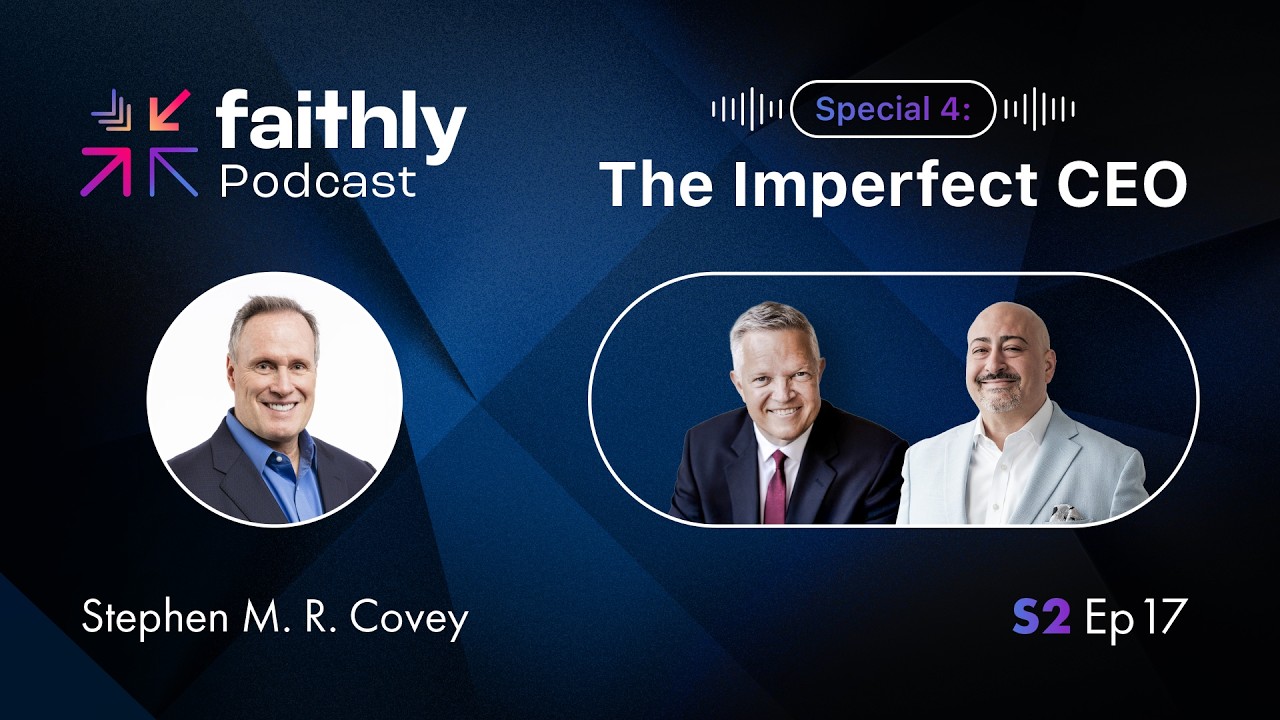


In this episode of The Imperfect CEO, a special series from the Faithly Podcast, Rev. Adam Durso is joined once more by Jim Brown and their guest bestselling author Stephen M.R. Covey for a compelling conversation on trust, accountability, and the hidden dynamics that shape organizational culture.
Together, they challenge the idea that agreement automatically equals unity, exploring how many leadership teams appear aligned on the surface while quietly struggling with artificial harmony or unspoken tension, conveying an underlying lack of genuine commitment. Stephen shares why true buy-in can never exist without involvement, while Jim highlights the dangers of environments where the real conversations only happen after the meeting ends.
At the heart of the discussion is a powerful leadership principle: healthy organizations are not built through control or uniformity, but through trust. From vulnerability and peer accountability to collaborative leadership and shared ownership, this conversation offers practical insight into what it takes to build cultures where people feel safe enough to contribute honestly and challenge constructively, allowing everyone to move forward together.
Website: https://www.franklincovey.com/
(00:00) The Leader Goes First
(02:00) The Illusion of Alignment on Leadership Teams
(04:22) Artificial Harmony and the Meeting After the Meeting
(07:19) How Trust Is Often Misunderstood
(10:03) Why Imperfect Leaders Must Admit Their Weaknesses
(12:32) Building Complementary Teams
(15:16) A Merger Case Study: When the Real Problem Is Trust
(18:12) The Four Peaks of The Imperfect CEO
(22:02) Peer Accountability and Supporting One Another
(25:33) What to Do When You Sense Something Is Unhealthy
(27:29) The Imperfect Leadership Movement and Next Steps
Connect with Jim Brown, and DM the word “BUILD" at linkedin.com/in/authorjimbrown for a free resource, and preorder your copy of The Imperfect CEO now at http://imperfectceobook.com/
Follow us on social media:
Website: https://faithly.co/
Facebook: https://www.facebook.com/thefaithlyco/
Instagram: https://www.instagram.com/faithly.co/
LinkedIn: https://www.linkedin.com/company/faithly/
X: https://x.com/faithlyco
00:00 - The Leader Goes First
02:00:00 - The Illusion of Alignment on Leadership Teams
04:22:00 - Artificial Harmony and the Meeting After the Meeting
07:19:00 - How Trust Is Often Misunderstood
10:03:00 - Why Imperfect Leaders Must Admit Their Weaknesses
12:32:00 - Building Complementary Teams
15:16:00 - A Merger Case Study: When the Real Problem Is Trust
18:12:00 - The Four Peaks of The Imperfect CEO
22:02:00 - Peer Accountability and Supporting One Another
25:33:00 - What to Do When You Sense Something Is Unhealthy
27:29:00 - The Imperfect Leadership Movement and Next Steps
At its core, leadership accountability means what I've been saying that the leader goes first. Yes, the leader models the behavior. Welcome to the Imperfect CEO, a special series by the Faithly podcast with your host Reverend Adam Durso and author Jim Brown. Welcome to another episode of Faithly podcast. My name is Pastor Adam Durso and I have the incredible opportunity to sit with two incredible leadership gurus, author, Stephen Covey, my friend. Just in the last few minutes, I got to share with you and tell you how much your teaching and your books have influenced, but I thank you for joining us today on this Faithly podcast. You're welcome Adam. I'm thrilled to be with you and also with my friend Jim Brown. Jim, this is the fourth episode of this special series on the Imperfect CEO. Jim is the author of the Imperfect CEO and he has also written the 20 year anniversary of the Imperfect Board Member and an incredible leader in the organizational health space. Jim, say hello to the audience. Well, hello everyone. We are actually kind of buzzing with excitement about the conversation that we're about to begin. So let's get into it. I'm super excited because Stephen, your work on trust, literally measurable, actionable, not to soft, but hard, edge economic driver in trust and then your work in organizational, I mean, it sets us up for tremendous conversation today across so many lines, whether you're in the full profit space, NGO and non-profit space, you're a pastor that's watching this around the country, around the globe. What is the illusion of alignment on 18 chip? Well, I'm sad to say that in a lot of cases, people on leadership teams just nod in agreement, but that's because they're not feeling like it's safe enough to express what they're really thinking. There's a expectation or an impression that the person in charge expects everyone to just do what they say. And often they would say that that's not what they're looking for, but there's something about how they behave, how they lead that casts that impression. So they don't actually know if people are in alignment with how they are giving direction. They just know that the people are being polite or obedient. How would you chime in? What would you say to that Stephen? I like what Jim just said. And what I would add is that oftentimes it's kind of just stated, sometimes even dictated or just kind of presented top down without a lot of involvement. And here's the issue, if there's no involvement, there's no commitment. And so in theory, we might be aligned technically, but people might be doing what Jim says, just going along with it, saying the right thing to create it, but they don't feel committed to it. And that's a real misalignment at the end of the day when you try to implement this, carry this out. We've got to involve people in the problem, and the opportunity, and the solution. And then we work up the path forward together. We do it with people, as opposed to two people, right, or even four people, and we just get different and kind outcomes, including around the alignment of what we're trying to do as a team. Yeah. What I love, though, is that there is a growing awareness about this. Okay. And it used to be that strong leaders would just declare the answers, the direction that everyone would be expected to march in step. That's not it anymore. That's absolutely not it. Okay. It might not have been it either, but it probably hasn't been it for quite a while. Yes. 10 years, maybe 20 years, but there are still people operating as if it is. And they have power, and so people don't challenge it. What do they do? They go and find somewhere else to work where they like the culture, the environment, the experience better. One of the terms, Jim, we've talked about is artificial harmony. Yes. What does that look like in the construct of a team when there's really not the safety to speak up and challenge the lack of health on a team? People just get along. People are polite. People are, they appear, friendly. So if someone were looking based on the body language, the words, it would appear that they're all getting along well. The real test is, what did they say when they're walking down the hall after the meeting is over? Are they excited about what was just decided? No. Sadly, more often they're not sure what else is decided. Not sure that they're in for whatever got said, complaining about what someone else said, somebody got all this credit, they're not getting credit. There's all these disappointments that are happening that don't get mentioned in the conversation, which happens to be the exact setting where something could be done about those things. It's, it's messy. It's not working, actually. Yeah, there's an expression, Minnesota nice, Midwestern nice, Midwestern. Nobody's saying that about the orchestra, but not about New York, because maybe Salt Lake City a little bit, you know, is where you're, you know, Midwestern nice, whether you S or Canada, kind of, you know, you go along to get along, you know, you're saying the right thing, but because you want to be respectful and appropriate, but what happens is, you know, to Jim's point, there's the meeting after the meeting. Right. And so you didn't talk about in the meeting, but you talk about these things after the meeting all the time, and anytime the real meeting is the meeting after the meeting, that's an issue. Yes. There's not enough safety, there's not enough trust, there's not enough, you know, openness and vulnerability, not being real. And yet it's so much easier to do that after the meeting. So that just speaks volumes to what the opportunity is, because to Jim's point, it's when we have everyone together that can actually come up with solutions, right? We can brainstorm, we can synergize, we can come up with something that involves everyone and is completely better than what we do in our own, but too often we just don't speak up, we can be able to feel safe. So how is trust misunderstood in an environment like that? I mean, I don't want to, you know, I don't want to talk about the New Yorkers, but we don't have been Westernized. So we're pretty confrontational, it happens in the room. But how is trust misunderstood when everybody's just placating towards somebody else around the table, and the real conversation's not really happening in the room? Yeah. I think where trust is misunderstood is that it means that we agree with each other. Because in that, we might completely disagree with each other, but it's, when we trust each other, our differences of how we view things, how we see things actually can become our strengths. It can become the source of creativity and innovation, differences coming together and even colliding sometimes in an environment of trust creates innovation, possibilities, opportunities. They become our strengths and too often it's kind of like, we've got to all kind of save the same thing and see everything the same to have the trust and I say, no, no, no, no. The trust is that we believe in each other's intentions, we have each other's backs, but it doesn't mean we see the world the same, right? In fact, we see it differently and that is our strength as we have this constructive conversation, this constructive dialogue, or even constructive conflict, it's Patrick Manzani will defer to it, but the starting point for that is trust that enables that to turn constructive and creative. So Jim, there's a difference between unity and uniformity? So big. Yes, you know, your eyes lit up, I'm just, I'm just thinking about how out of place and almost useless uniformity is now unity is the idea that we're linking arms and we are marching together because we are believing that this is worth it. What we're doing matters and we're going to do it together and make a difference. That's powerful. Uniformity has this old notion that if you were more like me, the whole world would be better. And if everyone were like me, that would be heavenly, actually, it would be awful. It would be awful because we would be missing so much. So I'm thinking about trust in that, especially in the leadership team context. I believe ultimately everything rises and falls on the leader. And the title of the book is the imperfect CEO, that's the leader of the organization. And what we're hoping that leaders would recognize is that they are imperfect. In fact, we all are imperfect. And if I would just admit that to myself and admit that to my leadership team, then we can start working with reality rather than a pretend notion, but no one actually believes it. You see, no one on the team thinks that I'm perfect. I just think I'm supposed to be perfect. If I can say, you know, I'm really looking forward to this conversation today because one of the things that I fall short in is understanding the marketing piece. And there's at least two people sitting in this at this table that really can bring some strength, please bring it because we got to figure out how to overcome this. Everyone in the room probably has a little bit of an extra breath. He just said that. They all know it already. Now they are recognizing that I'm admitting it, which means to them, maybe they could admit that they're not perfect and they won't be punished for it. The more important opportunity, this is the kind of constructive possibility that Stephen was getting at is that when I submit my weaknesses, other people can bring their strengths to cover my weaknesses. And together, we are actually better than we are based on the safe, but not trusting conditions that we're set up. So yes, this is my dream, I know this is also Stephen's dream, that leaders would be creating the context for their leadership teams to have the kinds of conversations that bring the best ideas to the conversation, ask the hardest questions, not because we're doubting someone around the table, we're just challenging the ideas and we're committed together to come up with the best answers and the best plans to make the biggest impact. I love it because if we all try to just pair the same thing and see the world the same, and at least one of us is unnecessary because what we want to tap is what Jim is describing, I call it a complimentary team where someone else's strengths are compensating for my weaknesses and vice versa. My strengths compensate for another's weaknesses, but the two common paired on we have as a leader is that I've got to be perfect, I don't have all the strengths, you know, that's why I'm the boss, that's why I'm the leader, I have all the strengths, but in fact, most leaders don't very few if any do, in fact, no one does really know, I think it's nobody, yeah, and we're imperfect, we're the imperfect CEO, the imperfect leader, but we know that we do this together collectively with each other as a team and so by modeling the behavior, by going first and saying, hey, you know, this is actually not my strength, everyone knows that already, and now I'm just acknowledging that I'm being open, I'm being vulnerable, people relate to that, it makes it safer then to say there's some things I can't do as good to when the leader is leading out and saying, this is not my strength, but I know that it's some of your strengths, and that's why we're collectively, we are a complimentary team, and you can help me here, and then that makes it safer for others to say, hey, this other area is not my strength, and maybe someone else can compliment those strengths, so the summer needs to go first, yes, the leader goes first, yeah, is there something I'll toss us to either of you, Steven or Jim, where you would say from your history, from your experience of working with organizations as extensively as you both have, or you'd say, this artificial harmony, this uniformity inside a unit showed up, and you can give the audience that's listening right now, a peek into without any names, we don't want you to call anybody out, but where we say, hey, you know what, we saw this, and we were able to tweak it in such a way, we were able to build trust in the midst of diversity, and really change the trajectory of that organizational company. Sure, I'll tell you a situation where these two companies had merged, and they wrote in technology space, they'd come together to create something better, but they were a year and a half into the merger, and it wasn't better, they were not achieving what they intended to achieve, and they were not getting the synergies they thought they could get. They were not creating the kind of product and offerings that they thought they could do, and the issue was not that it was a bad idea to merge, it actually made a lot of sense strategically, and it wasn't that they didn't have the right channels of distribution or the right R&D or the right products, or the right technologies, they had all the things, the problem is that they didn't trust each other, they saw the world from the different vantage point that they came in, the two different sides, and they had divided into camps, and those camps were persisting a year and a half into the merger, and they finally realized their problem was not strategy, it was trust, and they had to learn to extend trust to each other, to give it, not just to be trustworthy, but to be trustee to their own new colleagues that have come together, and what was remarkable about it is that after a year and a half, they saw this for the first time, and they recognized, this is our issue, trust, and so we worked with them on saying, if we can build trust among this team as a starting point, then we can model this to the organization, and this will enable us to do everything else that were trying to do better, but until then, they were just kind of operating as two autonomous groups that were having to work together from time to time and find ways to coordinate, but they were not collaborating, Jim talks about the collaborative culture, and they needed the trust to do it, but again, someone needs to go first between these two teams, each side of this merger needed to go first with the other, to see trustee as well as trustworthy. Yeah, it's so good. I want to just pick up on that whole point of collaborative culture. Yeah, we believe it's the center point for any organization to actually make a big impact in the world, whether, again, whether it's a business that's trying to win a market or a non-profit that's trying to change the world, make things better, it's only when we learn to really bring our strengths and weaknesses together, best ideas, and collaborate that that becomes possible. That's one of four peaks that I talk about in the imperfect CEO. Let's go over them, so it's collaborative culture, then the next step is leadership accountability. Then we want to have strategic momentum and finally talent magnetism. I'm bringing this up because I especially want Steven to speak about that second-piece leadership accountability. He has done such fabulous work on helping people understand accountability in a way that inspires people to be their best, as opposed to requires people to do their job. It's a totally different mindset, and what we're talking about in the imperfect CEO is the choice to be accountable, as opposed to the system that requires it. Can you help us? I'm imagining leaders reading this book and saying, oh, sure, accountability, that's so important, but the gut history that confuses what that really should look like. Help us with this, please. Yeah. I think it's a great, you know, key tenant to one of your four that is so vital. Let me just give this at its core. Leadership accountability means what I've been saying that the leader goes first. Yes. The leader models the behavior that they would like to see. If we want more openness and transparency, the leader models first openness and transparency. We want to demonstrate more respect. And the leader models first demonstrating respect and on and on and on. And so that's the gist of it is the leadership accountability is that they are leading the way. They are modeling what we're trying to do. They're going first. And so part of this comes to kind of reframing how we think about accountability. Not as punishment and punitive and it so often gets the sense of, hey, you're going to trust me or hold me accountable as if they were different things. It's saying this is a stewardship we have. Yes. And we're accountable to this stewardship. A stewardship is a job with a trust. And as a leader, we have a job with a trust to lead those that we're working with and to model, to trust them, to inspire them. These are stewardship responsibilities that we have to go first. So we've kind of reframe accountability. Not around you know, again, the punishment or the, or the, I'm going to catch you in this and that, but rather as this is stewardship and we're building agreements together around what we're going to do together. And I'm showing that I'm doing my piece. And therefore you can do your piece too. And we're doing this together. And it really becomes almost a, it's a leader accountability, but it becomes almost a team accountable, a peer accountability because we are accountable to each other. Yes. We're in the same team. We're doing this together. And again, we get enough people modeling this. Suddenly, team accountability, peer to peer accountability on the team is so much more powerful than hierarchical top down accountability. We're, it feels like someone is micromanaging and judging me versus I'm reporting back on my stewardship and how I'm doing. Or I'm reporting as a leader to the team on my stewardship and how I'm doing where I'm falling short and where I need their help. Yeah. I'm, I'm just thinking one of the things we really believe is that the whole mark of a healthy leadership team is when members of the team are holding each other accountable, not the boss repairing it. And when I, even that, it's interpreted to not mean what I just said. When I say holding each other accountable, Stephen just said the example is I'm sharing what I'm getting done and where I'm falling short. And I'm not afraid that someone is going to look, fold their arms, look down their nose at me like you're just not doing your job. No, they're going to lean in and say, Oh, what do we need to do to help you? Because they want me to succeed. They're not competing with me. We're in this together. It's, it's an accountability of getting the outcome together as opposed to winning in comparison. And that's a whole different mindset which comes back to it's about a collaborative culture. We're doing this together not, boy, I'm going to show them how great I am. In the new world, you'll show that by how well you support each other, you, yeah, you bring your strengths and let it cover other people's weaknesses. I'll give you an example of this. And I have permission to share this company's name. So one of the clients that I've worked with and, and is the pennant group in, in healthcare, home health in hospice, also senior living. And they have organized themselves in a way that they have these independent hospice agencies, home health agencies, and senior living facilities. They operate independently, but more importantly, they actually operates operate in what they call clusters, where they bring together like four or five or six of them into a market cluster, where they try to learn from each other and understand best practices and learnings and insights. But these clusters come together, where the leaders come together, these separate units and are basically accountable to each other and with each other on applying best practices and learnings. And if someone is struggling, one of the six units say a struggling, everyone in this market team tries to come to the aid and the help of the other in the struggling. And then that person is trying to then take the help they're getting and apply it and learn and become better, because they know and turn, they're going to try to help another unit become better later when they're struggling. And the why can't they built this extraordinary pair of accountability system, where in it and the accountability is really just a sense of partnership. We're collaborating together and we're in this together. Yes, we have separate entities, we're independent, but we're also interdependent as a market team. And interdependence is a choice that only independent people can make. So they do this individually, they do it collectively, but they go to a whole different level with this peer accountability. And they feel far more responsible to their peers, even than they might do to a boss, just because they fill that sense of we are we're partners and we're in this together. And it's amazing what that does. It inspires people to want to be the very best self. If there's somebody listening to this podcast, watching this podcast right now, and they know there's something, there's something wrong, there's something that's just not healthy about the leadership team, because let's be honest, the CEO, the imperfect CEO's not just written for the imperfect CEO, it's written for the senior team. And staff members that are working together who are progressively trying to get better and create an environment that's healthier. What would you say to that person and say, Hey, flag on the play, I can see it, I can sense it from this conversation. There's something wrong. What would you say to them? Well, we believe that that most people in an organization actually want their organization to do well. Yes, they want to know what they can do to help make that happen. So I would encourage leaders that are recognizing, there's an opportunity here. There's power in shared language. So rather than, oh, you buy this book and you're, oh, that's so, that's so helpful. Boy, I really want to see that happen. You likely won't, if you start trying to tell everyone to do it. But if you've got more people to read the book, and it's a readable book, it's written as a story, rather like a text book. So it's easy for people to read. I love that. You know, your book's written as a fable. I don't feel like even though you're pinpointing areas of concern or things that are unhealthy, I don't feel like it's attacking me as if maybe a book that was more straightforward on that would be good. Good. And my aim is that people would see themselves in the story and that they would see that there's something they could do to help their organization be more healthy. And if a critical mass of people would read that book, all of the leadership team and maybe the next layer of leaders as well, then then we can start having the right conversations and move together to make a difference. We're trying to help leaders create healthy organizations because we think the whole world can change with that. You coined this the imperfect leadership movement. Where did people find out more information about that? I would encourage people to visit the website imperfectcobook.com. Say that one more time, Jim. Imperfectcobook.com. There's a video where I talk about the movement. There's other resources and there's some packages that make not just so you can buy more books, but you can get some more tools that will help you implement this in your entire organization. And Steven, you and Jim have had a relationship for 20 years now working together such tremendous affinity, not only for each other, but the model between trust and the asset model. What would you say about the book? Well, I agree with what Jim just said that if you get people a common language and a framework so we're kind of thinking and talking in the same way that that enables so much because you can get so much more done. That's the strength of this. And so I was honored to be able to write the forward for this book. And I did it for two reasons. Well, three. First, Jim asked me. Secondly, because I admire him so much because he actually models this and he's the Imperfect Consultant coach. Yes, sir. It's over for who Jim is. That's why. But also because the last reason is because this is so aligned with my work. And I just wrote this recent book, Trust and Inspire, describing kind of the kind of leadership needed today. And this is that's my language and my approach. What Jim is doing here is kind of his language, his approach of a very similar idea where leadership is going. And in towards this Imperfect Movement, towards what I call Trust and Inspire versus the old traditional command and control hierarchical models of the perfect leader. This is the Imperfect Leader. And so from command and control to trust and inspire from the perfect leader to the Imperfect Leader. And and that is the kind of shift that needs to take place because again, we're modeling as leaders. We're trying to go first in being both trustworthy. That includes being, you know, showing the way modeling, being authentic, being vulnerable as Jim was talking about earlier, but also in being trusting, extending that trust, giving that trust. There's a rest of that. There's going to build it to that. But that's what unleashes the potential, the greatness, the talent that's inside of everybody. And so what I'm about, what Jim's about is aligned. Yes. They're trying to unleash potential in talent. Way to put a bow on it, Stephen. That's incredible. I want to thank you for joining us for this faithly podcast. I want to thank my guests, Stephen Mark Covey and your contribution to this work in Jim Brown, the Imperfect CEO. Thank you so much for this conversation. We're going to continue to go deeper. So look on all the podcasts and platforms and social media platforms as we continue this conversation to build healthier organizations. Have a great day.