


Special 5: The Imperfect CEO - Jimmy Mellado | Faithly Podcast


What actually creates a healthy organizational culture, and why does it matter so much?
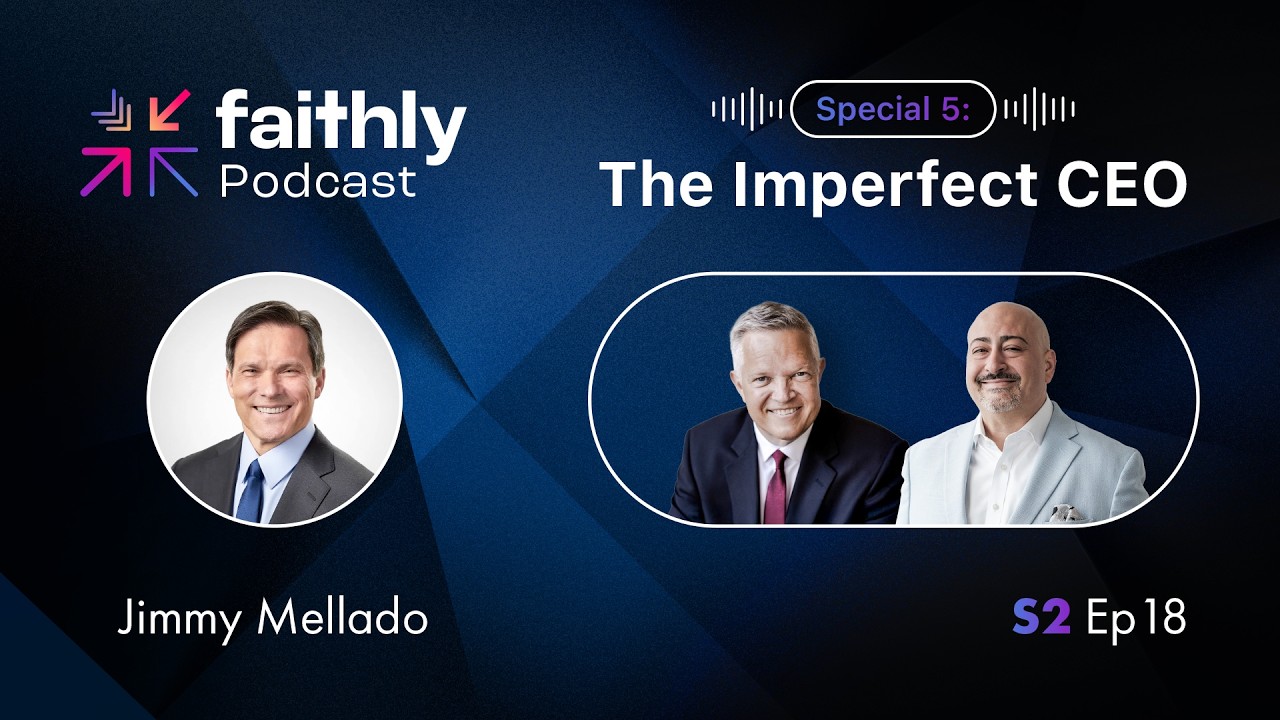
In this episode of The Imperfect CEO, Rev. Adam Durso and Jim Brown welcome Jimmy Mellado, President and CEO of Compassion International, for a rich conversation on leadership, trust, and the kind of culture that helps both people and mission thrive.
Rather than stepping into leadership with a need to immediately change everything, Jimmy reflects on approaching Compassion with a posture of listening first—learning the culture, understanding the people, and discerning what God was already doing before attempting to lead organizational change. From there, the discussion unpacks how healthy culture is intentionally built through behaviors, accountability, feedback, and leadership consistency rather than through slogans or aspirational values.
Together, the trio explores Compassion’s five key cultural behaviors and dive into everything from psychological safety and humility to honest disagreement and leadership accountability. At the center of today’s episode is a compelling idea: culture is not secondary to performance, it is often the multiplier that determines whether people merely function or truly flourish.
Website: https://www.compassion.com/
(00:00) Selecting the Right Leaders for Culture
(00:49) Culture as a Performance Multiplier
(02:04) What Healthy Culture Looks Like at Compassion International
(04:36) Listening, Learning, Loving, Then Leading
(05:31) Building on Compassion’s Existing Culture
(07:39) Behaviors Versus Values
(08:24) Compassion’s Five Cultural Behaviors
(13:39) When Leaders Inherit a Toxic Culture
(17:24) Collaborative Culture and Leadership Accountability
(20:23) The Difference Between Niceness and Kindness
(25:17) Guarding and Sustaining Healthy Culture
(29:17) Integrity in What You Are Building
(35:58) Why Healthy Organizations Impact the Whole World
Connect with Jim Brown, and DM the word “BUILD" at linkedin.com/in/authorjimbrown for a free resource, and preorder your copy of The Imperfect CEO now at http://imperfectceobook.com/
Follow us on social media:
Website: https://faithly.co/
Facebook: https://www.facebook.com/thefaithlyco/
Instagram: https://www.instagram.com/faithly.co/
LinkedIn: https://www.linkedin.com/company/faithly/
X: https://x.com/faithlyco
00:00 - Selecting the Right Leaders for Culture
49:00 - Culture as a Performance Multiplier
02:04:00 - What Healthy Culture Looks Like at Compassion International
04:36:00 - Listening, Learning, Loving, Then Leading
05:31:00 - Building on Compassion’s Existing Culture
07:39:00 - Behaviors Versus Values
08:24:00 - Compassion’s Five Cultural Behaviors
13:39:00 - When Leaders Inherit a Toxic Culture
17:24:00 - Collaborative Culture and Leadership Accountability
20:23:00 - The Difference Between Niceness and Kindness
25:17:00 - Guarding and Sustaining Healthy Culture
29:17:00 - Integrity in What You Are Building
35:58:00 - Why Healthy Organizations Impact the Whole World
70% of our leadership development culture strategy is selecting the right leaders. Welcome to the Imperfect CEO, a special series by the Faithly Podcast with your host, Reverend Adam Durso, and author Jim Brown. Welcome to another episode of Faithly Podcast. My name is Pastor Adam Durso, and I am joined today by author Jim Brown, the author of the Imperfect CEO, say hello to the audience Jim. Hello everyone, great to be with you. And my good friend for more than 20 years, he is the President and CEO at Compassion International, Jimmy Mayato. Good to see you again, Adam. It is so good to be with both of you. This series on the Imperfect CEO, we've been talking about the role of culture as a performance multiplier. Why don't you set that conversation up a little bit, Jim, and then we'll we'll toss it to Jimmy, and I'll make sure I don't get you guys confused with the Jimmy Jimmy thing. Well, we believe, and we see that the difference maker has become culture in organizations, every kind of organization. I'm excited for the conversation with you, Jimmy, because the focus of a large organization that you're leading, people tend to feel like, oh, that's unique. We had a great conversation about the corporate setting. We've had good church setting conversations, but actually a healthy culture matters in every type of organization. When people can feel like it's safe to be their best version of themselves, bring their best ideas, ask their hardest questions, admit where they need help, then we can work together and best things happen. So we're definitely wanting to dig deep into how you've been making that happen here in Compassion International and apply those principles for any of our listeners. So what does a healthy culture look like in a large global NGO? Well, it is the foundation I talked about. And I remember when I came to Compassion, it's been 13 years now. As soon as it was announced that I was coming, it had breakfast with a university president, and no king. As soon as we sat down, he belts out a question, now that you're going to Compassion, what's going to be your leadership, what's going to be your vision for Compassion? And I was like, man, I didn't got in there. But I'll tell you the first thing I thought was, first thought was, I'm actually not interested in my vision for Compassion. I'm very interested in God's vision for Compassion. So I need to be a student of that. I need to study and learn and listen and take in what God has already been doing inside of Compassion. This is a ministry that's going to celebrate its 75th anniversary next year. So a lot of history that came before me that I had to honor because that's what I was stepping into. But second to that thought that I don't want to do my vision for Compassion. I wouldn't do God's vision for Compassion. And I need to take time to immerse myself in the culture to then allow the leadership gift over time to the beginning, setting strategy and choosing this and not choosing that, allocating resources, hiring and building a team and all of that. Before any of that, I knew what kind of culture we would want to have because that was key. And I really got it from inside of Compassion. Its mission is to release children from poverty and the most important phrase in the mission is in Jesus' name. So if we're going to do it in his name, then we better do it in his way. It doesn't matter what your strategy is. Sure. And one of the great privileges of mine was spending some time with the late Peter Drucker before he passed. Mutual friend Bob Euford put us together and we had fabulous conversation. And of course, he has that amazing quote about culture. Culture eats strategy for my show all the time. But to hear directly from him was really kind of cool. So I came in with a deep appreciation for no matter the strategy, we got to start working on culture. And how much of that was influenced by your predecessor, West African spending time with him, how much of it was influenced by asking the employees of compassion and seeking their insights around the current culture so that you could navigate toward what God wanted for compassion under your leadership. Well, you just described what I did when I first stepped in and that was to take a listening posture. Instead of imposing something on compassion, I wanted to see what God was already doing at compassion and joined that. And that does include culture. So there was a listening phase and a learning phase and then loving just love the people before you lead them. And then lead kind of in that order of listening and learning and loving and then leading. That was the posture I took. So I asked a ton of questions, West, other leaders, people around the world about compassion just took that listening posture. And wonderfully, I had met West back in 1994. I think we've been, you know, a 32 year history of relationship with him. So I knew him real well. And I knew what I was joining inside of compassion, our ministry's partner together. So there was a culture that I was actually attracted to. And so in terms of being intentional about culture, it was not coming from a position of throwing the old out and establishing something new. No, it was understanding what God had already been doing in that culture foundation inside of compassion and just adding more intentionality around that because you, you never drift into great culture, right? You just don't. You don't accidentally get there. And if you're trusting and hoping that it's going to turn out, it probably won't. So there were some real specific things that we did to try to not drift into maintaining the good culture that was inside of compassion because we did want to commit to if we're going to do it in his way. I'm sorry, if we're going to do it in his name, we must do it in his way. Sure. So that was kind of foundation. We brought Henry Cloudin, who's clinical psychologist, executive leadership coach, and has been with us ever since coaching and helping us. And we entered into a very intentional process of asking our staff about our culture, just ask people what's described the culture that we're in. And then we asked another question, what's the culture you would like to have? Because every culture has good things, bad things going on. So we wanted to learn and listen and hear from the people that were actually living in the culture. And then out of that, when we looked at the compassion's history, looked at what was looked at what in the moment, the reality of how people describe the culture and some things about it that they wanted to, in fact, build and enhance, we were able to identify five behaviors that reflected the kinds of behaviors that we knew if people engaged these kinds of behaviors on a daily basis, that we would build the kind of culture, the kind of environment that we would want inside of compassion where everyone could fully flourish and bring what you said their best, their gifts, talents, experiences, and put them on the table. And let's, let's, let's move forward together. So and those, and let me talk a little bit about behaviors versus values. So it's like organizations have values. And we did too. They're amazing. They're foundations. So our values around integrity and discernment, dignity, stewardship, excellence. That's, those are great values. But Henry encouraged just to get a lower, describe the actual behaviors you're wanting people to engage. And so that's what we were able to distill. You go to any office of our dozens and dozens of offices around the world. You will see these five cultural behaviors exhibited on the walls, but not just there lived out in their, in their experience. So those five behaviors were, by the way, we're here, number once, we're here for a reason, the mission. Like we're here together because we have a mission to accomplish and our behaviors around goals and accountability and, and doing what you say you're going to do, all that flows out of we're here to get a job done. God's given us a mission. So our behaviors flow out of wanting to honor that mission. Number two, we're serious about growth, not just yours. We're serious about growth, ours and others. So every time you show up, I create an environment for you that's either positive or negative. You create an environment for me. That's culture. So we all have to be owners of culture. So we got to be serious about growth, ours and others. 100% for one another, third and one. We got to be all in for each other. Now there was a subset of that one. 100% for one another. That was careful with words. And you got to be careful with words if you're 100% for one another. But you know, this little guy has great power to do good and bad. The bottle says something about it. It does. I can say about the power of the time. Yes, it does. So Henry Cloud recommended you said, you know what? It is all about being 100% for one another. It's so important. And it's power to do damage is so big. Let's make it its own thing. So that became our fourth behavior. Careful with words. Watch what you say. Watch what you write. How what's the tone of that email? How do you not only just act, but how do you react to stuff? Just be careful with what comes out of here or in your written words. And then the final one was invite others in. And that was another one that that was Henry Cloud spoke into that one as well. Because it used to be let others in. And Henry said, that's not good enough. We all have needs. And if you don't recognize you have needs, you don't invite others in. Now, taking a posture, if you want to give me feedback, I'll let you give me feedback. That's not good enough. You got to you got to get out of your seat and you got to go get that feedback. You got to go invite that feedback into your life. Because it's not going to drift your way. If it does, it's not enough. Yes. So go out and get it. So those five behaviors here for reason, the mission, seriously about growth, ours and others, 100% for one another. Careful with our words and invite others in. Those behaviors are now on the walls all around our world. But you know, you got it's got to be more than just on the wall. So the way we made it, real in our environment is a number of things. We started to engage practices that got institutionalized that forced us to have conversations around these behaviors. So on everybody's performance development plan, mine included, we talk about how you're doing with the behaviors. Is there one in particular you want to work on in this next season? Is there some we can celebrate that you've been doing great in, you know, letting others in or inviting others in. Sorry, even I did it there, letting others invite others in. So how are we doing on that? That's also with groups. You can't move together if this functional group isn't inviting this functional group into their plans. So it works beyond interpersonal. It's between groups as well. Are we living out these behaviors and have those conversations? We celebrate victories on on our behaviors and let people know I'm ever seen one from Southeast Asia. And the group there was doing an amazing job with celebrating how others were expressing the cultural behaviors in their office. And then we measure. If you're leading an organization and you're not measuring cultural dynamics, there's no way you're going to build the kind of culture you want. You got to measure. You got to let people give you feedback and invite others in to tell you how we doing as a ministry is leadership, living out these cultural behaviors. And we have other things too that we look at engagement, psychological safety development, other other kinds of things. And we take that feedback and we expect every manager to have conversations with their teams about how they're doing in engagement, which is a significant part of culture and culture behaviors, other things as well. So you measure what matters most. There are culture matters. So there are amazing organizations out there that can provide tools to help you measure culture on an annual basis. So you can see the trend line over time. Now we have developed our own tool. So we measure and look at the trend line on how we're doing on culture, but structure, process, institutionalize it, get clear on it, and measure it. And that's how we've come to help everyone be an owner of culture. Can't just be me. Yes, everybody has to own the fact every day they're contributing or detracting from the kind of culture we want to have. Adam, I'm laughing the way. So Jimmy, this is this is why I wanted us to have this conversation. I've been tracking with you for certainly more than two decades. Yeah. I knew that this is so in you that you've been living this. And we have listeners, Adam, that I'm hoping that they're going to go back and listen to that 10 minute explanation. Yes, like five times because it's embedded with at least a half a dozen key concepts that are crucial if we want to lead healthy organizations. Jimmy, let's admit you were you were blessed and fortunate to land in an organization that already had done some good work in this in this area. Yeah. The truth, sadly, is that some people get parachuted into an organization and the culture is toxic. Yeah. And it's the question isn't what should we hold on to? The question is how do we work together to make it a place where any of you actually want to stay? So thank you, God, that that foundation was there. You know, we actually asked that question. Interesting. Do you have thoughts of wanting to work elsewhere? Good, good. Just the fact that you ask it means it's okay to talk about this. Yeah. And we want to make everyone feel like there's no thought that is out of bounds. If you wondered about this, somebody that you're working with, you should be talking and processing this and praying, right, together about this. And one of the things that I want to have be normal in the environment and in many respects, there are many pockets where it is is celebrating when those difficult conversations happen. Yesterday, I was in a meeting intense all day meeting with with leadership. And there was a particular topic for which there was serious disagreement, serious disagreement. And you listen to one side, good rationale, you listen to the other side, good rationale. Now we got to sort our way into moving together. And we have to make resolution on a path forward for sure. But the fact that everybody was able to share, I was at the end of the deal. And this is I think good for every leader to do. Anytime it happens, celebrate it, highlight it. And I did that at the end of the meeting. I said, before we end, I just want to thank everybody for leaning in fully. And I know there was some serious disagreement going on very intense. And that's awesome because that's what's needed to land us to where we need to go. Everybody needs to feel like they can bring their best to the table. There's enough psychological safety and other thing we measure to be able to show up and it be okay. I have words, folks that help me on the words and talks and things like that. And a person helps me with that challenges me about, I don't think we should say it that way. I don't think you should say this. And you know, she's right about a hundred percent of the time. So when I appreciate the fact that she can, you said that she might be listening to this podcast. She will. But I leaders have to reinforce the kinds of behaviors that they want to see happen again. Yes. So when someone, it's a discipline of mine as a little micro spiritual discipline, when someone challenges me, disagrees with me, I thank them for that. That's a part of a discipline for me to appreciate and own that because like we all have blind spots. And it's a gift when folks can share them. Right. Hey, I want to jump in Adam because what Jimmy's explaining is the application of so much of what's in the book, the imperfect CEO, that foundation that you talked about of working together and feeling like it's safe to share your thoughts. That is all about collaborative culture that people are committed to working together. It's that's link arms. Let's believe that we're better together actually. Let's try to get rid of any competitive spirit. Right. It's, it's not about someone's better than someone else. Everyone's better than someone else in some regard. Let's, let's make the best place where that can be evident. And we're going to build on that. And then you're talking about the next pillar in the model, the peak of leadership accountability. This is all part of your set model. The ascent and there are four peaks in there. Why don't you just say that? So it's collaborative culture. Then we go to leadership accountability, strategic momentum, and finally talent magnetism. So when, when Jimmy is describing what, what he's admitting to your communications person that, yeah, maybe that's not the best way to say it. And she's right 100% of the time roughly. This is humility in action. I bet if we tracked the behaviors that you were underscoring for every organization, every office in your organization, that you are very intentional about exemplifying those behaviors. And that's what leadership accountability is all about. And you've heard me say out of that surprisingly, that of the four peaks, that's the one that is usually the lowest rated one, accountability. Yes. Wow. Wow. Which is actually a horrifying thought because it is also the one that the leaders have the most control over. Explain that a little bit. I mean, you're saying leadership accountability is the one that's least likely to be instituted. And yet the one we probably have the most control over. Right. I can't control what, you can't control what 2500 people across your organization behave like. You can only create the groundwork that makes it clear what those expectations are and foster culture then makes it possible. But leadership accountability is mostly about the core leadership team, senior leadership team, agreeing together on what those foundation pieces are and then living it so clearly, so with such commitment that no one wonders, do they really believe those things? Well, I'll tell you where the rubber hits the road in a in a mystery setting where we sometimes in Christian ministry settings, we suffer from a terminal case of niceness and not kindness. And Henry Cloud helped us kind of discern there's a difference between being nice and being kind. So big. Being kind is, I say hard things that need to be said. But I hope you do it in kind ways. In kind ways, for sure, say it in love, truth in love for sure. But just superficially being nice and never challenging allows things to live under the radar screen. Right. And passive aggressiveness kind of built us through and which is just destructive to culture. But but one of the most destructive things to having consistent growth, building the kind of culture that you want is when people see leaders violating. When they see leaders that are not living out the culture behaviors, and it could be that maybe they're 95% on the mark. Yeah. Problem is that when you're a leader, the 5% that you're off is the 5% that's probably most damaging to your team and other teams that observe. And it's what everybody notices and talks about. And then they talk about it to others. I saw that leader doing this. So it's it's terribly destructive. And it's so important from accountability point of view. I mean, just the hardest part of it is that great cultures have an immunity system within themselves that is able to identify the virus and deal with it. Great cultures that are not great viruses are everywhere. ramp up. Great cultures deal with it. And sometimes that's doing hard things. I've let folks go primarily because of culture violations than performance on the like tactical outcomes. Like let's not miss this. This is most dismissals are about performance. And sadly, the problems regarding culture, we turn a blind eye to it. And that's a cancer that just keeps multiplying through the organization. And I know that in every leader will identify with this, you want talent. Talent matters. But if you bring in that talent and it doesn't fit the culture menu pay. Yes. And and the culture pays and everybody pays. And have I learned my lesson from more than once having made the mistake of being attracted to talent more than what they might bring to the culture. The other thing about strong cultures. I remember real good friends with the leaders at Chick-fil-A. And I asked them one question one time, tell me about your leadership and culture development strategy. So I was expecting all sorts of wonderful things like onboarding strategies and development strategies and how they taught on it and what their frameworks are. And that's all great. But he smiled at me and he said, this is head of leadership development at the time. You talk about Mark Miller. Mark Miller. Yeah. I know Mark, he's such a authority in this. You're another guy totally. So many smiles and he goes, Jimmy, I'm probably going to say something that's not going to kind of, you know, be satisfying to you. 70% of our leadership development culture strategy is selecting the right leaders. That already bring the kind of culture we know will be consistent with Chick-fil-A. So you hire, you bring in people on the talent acquisition side that are going to be a fit with the best parts of the culture you want in your organization. And I actually, not too long ago, about two months ago, I was talking to one of our fabulous talent acquisition individuals, and they told me that there was this person that hit all the checkmarks on talent, experience, and skill, but did not move that candidate forward because of one thing. They lacked humility, and she knew that the lack of humility in this environment is not going to work. It is not going to work. And that's true. So I want to commend you that you've become not just you. Your leadership body has become so conscious of what those things are that you're making sure it's happening. And that's what great leaders do, Adam. We, as leaders, figure out what is it that allows for us to have a healthy culture and sustains the culture, and then we guard that with great commitment. Yes. Again, who often culture is like this nice idea that's so soft, that truly it'll be fine. I'm really hopeful, and I believe that there's a increased momentum of a greater awareness that, no, it's not soft. It's actually the hardest part of leading a great organization. But if we can get it right, or I do think start to build on that a little bit, the analogy that's in my mind about how to work that in an environment with thousands of individuals is not unlike how I view just spiritual formation in my own life. Yeah. I engage certain practices and experiences, disciplines, if you will, that help me do what I cannot do through trying alone. I want to be like Christ. But if I don't have structured, if I don't invite grace into my life, which needs to come in the form of a structure often, that's how it gets expressed in my life, a certain amount of discipline, a certain amount of rhythm, a certain amount of intentionality that is going to allow me to grow in areas so that I can become the kind of person that naturally, reflexively and organically exhibits the things that build good culture and grow me up spiritually. And we often say in compassion, your most important contribution to compassion is actually not what you do. Now, we do a real important thing. We do a life-saving thing with children living in poverty all around the world. It is super important. It's not the most important thing. The most important thing is, and the most important contribution you'll make to compassion is actually the person you're becoming. The doing needs to be the natural organic fruit of the kind of person you're becoming. And that's what gives that fruit eternal value, eternal meaning. And if we're all becoming more like Christ, daily, I'm helping you grow, you're helping me grow, we're starting to build that kind of strong culture, where we're all moving toward the same North, true North star there of wanting to be more like Christ and understanding that what I do is important, but how I do it is what makes it eternally important and invaluable when spirits behind. It sounds like faith is integral in your leadership completely. How do you ensure that what you're suggesting there, that your faith is being demonstrated in your leadership and then being reflected in how you operate, communicate, deal with the people that are working closest to you, and then spreading that in a way that's impacting literally around the globe. I mean, I've been with you, I've been to offices in Africa and Asia and all over the world, and you see this modeled. How is that faith integration being spread throughout the compassion or the global formation is happening every second of every day. It's either helping you be formed well or malformed, but formation is happening every day, spiritual formation is happening every second of every day. So you can say, here's my spiritual life, and here's my vocational life. Yes. They are inseparable. Henry Kyle talks a lot about this in his book Integrity. Yes. Integrity is everything that's in your life is integral. You can't say, here's my vocational life, here's my spiritual life. Spiritual life is completely encompassing of everything. That's reality. To live in that non-reality is in fact not living with how things really work. Right. So if every moment is a moment for formation or not, then classes in session every day. Yes. Classes in session every second. I might get a horrible email and I go, man, now I gotta deal with that. I mean, that's the last thing I needed. So I'm dealing with this bad email. My assistant comes in the door, has no idea. I just read a bad email and I'm having to deal with that. If I take it out on her, that is a malformed opportunity for my soul. I know I've affected her in a bad way as well. So every action, every reaction, how I write that email, how I respond, all of that stuff is in the context of formation class is in session constantly and every opportunity is an opportunity for me to be malformed or well formed. So it's true for me, it's true for all of us. So every opportunity is an opportunity for us inside of compassion to either malform our culture or well form our culture. And then we each, as leaders, have the opportunity to see this development, this email as a, it's not a distraction from your job. Actually, it's an opportunity. It's only an opportunity for Jimmy personally to actually exercise that he is fully surrendered to the Holy Spirit and this is not going to distract him. He's going to be the best version of Jimmy in the power of Christ in that moment for yourself. But then you're going to work with the person that sent that email because there's a formation opportunity right there. And then when your assistant comes in and you unintentionally bark at her, you either catch yourself or she catches you. And she's not punishing you or chastising you. She is graciously reminding you that, hey, we're all working on this formation thing. And there's a, there's for leaders, anyone actually, there's a discipline that I've kind of put in my life that speaks to the intentionality and some structure in my life to think about these things. But I want to be relationally consistent. Doesn't mean I have to always be happy or whatever. But if I'm relationally consistent in my sadness as in my joyfulness, that's what I want to bring people. So they don't have to worry. Oh, oh, is Jimmy having a good day today? Yeah, I don't know if I want to share with him this or that. I might not, how's it, you know, so I want to learn how to be relationally consistent in the mountaintop and the valley. Because that's what creates psychological safety on behalf of the people that are around that leader. Right. And another discipline I have in my mind is every day, I feel like I figuratively but a working helmet on my head because I'm going to be a wall record every day to destroy the walls that are being built around me all the time just by being here another day. And the longer a leader leads in one place, the more the walls get built around them, sometimes of their own choosing when they people build walls around themselves, sometimes because maybe they're not doing it, but other people are building walls around them because oh, they're in that position. But nonetheless, walls are getting built. No matter who built them, I got to destroy those walls every day so that I can stay connected in community because life and leadership are hard. Life and leadership alone is impossible. Right. You will end up in a, you will end up in a ditch if you're trying to do this alone. Yes. So let your community end to help you do life. You don't end up in that. What I keep hearing from the vote of you is there's a distinction between progress and perfection. We're not aiming to be, Jim, I'll just say this. I mean, you're building this imperfect leadership movement. Yes. I'm so glad it didn't say perfect because in 30 years of my leadership, perfect doesn't show up on Adam's radar anywhere. That's what attracted me to the book of the first place. He's a meeting reality. So when the audience is listening in on this and and and wants to find out more about the imperfect CEO, which is not just for CEOs, it's for imperfect leaders. Where do they need to go so that they can find this information and take into the book itself? I would encourage them to visit the website imperfectcobook.com. Can you say that one more time? imperfectcobook.com. There's resources, links to videos that they that they can watch and learn a little bit more. There's also some packages where if they would order some books, they actually get a whole bunch of other tools that will help them not just understand it, but implement these things. It's my belief, Adam, that a critical piece of changing culture or forming culture is helping everyone have the same shared language. And this can be a tool. If you're trying to figure out, well, how do we create a healthy culture in your organization? I'd encourage you to skip by a bunch of these books and start using the resources that are available that allow you to use these books to have conversations. So what does a collaborative culture really look like? How do we make that happen in our organization? It's really tools to help them go through the kind of work that you did with Henry's great help. Wouldn't it be wonderful if not just a dozen organizations did this? Because here's the thing, and I'm sure that you've experienced some of this, Jimmy, when people come to work, they're either going to have a day that makes them feel better about themselves or not. And then they go home. Do you know that over two-thirds of the population of America declared that they'd rather not work where they work? They would prefer a job somewhere else. Now, there's a whole lot of other problems connected to that because they don't go looking for a job. They just say, they stay there, not like yet. But they go home, dissatisfied. And then they kick the dog or whatever. They're not the best version of themselves. But if we as leaders, but create an experience so that people that show up for work feel valued and useful, and they're doing something that matters in the world, they go home feeling better about themselves. And they engage with their family in a way that's better for them. They come back and they engage in a way that's more fruitful for the organization, which likely means you're more productive. And if things are operating properly, that means they're going to be better rewarded. And then they go home. What I'm getting at is if we could create healthy organizations, it ripples through the entire world. Everything gets better. Yeah. Jim, more time. What's that website set up? People can find it in perfect CEO book.com. Find lots of resources at that website. I am excited about a going deeper segment where we're going to drill down into a couple of things in a special going deeper opportunity that you can be able to listen in on. I am excited. This has been an incredible conversation. My guest Jim Brown, Jim Mayato, president and CEO of Compassion International. You're going to want to continue to follow along with Faithly and all the social handles. This has been a Faithly podcast. Have a great day.